You’ll find the OneBlade Pro justifies its premium price through superior articulation, extended battery life, and enhanced precision on curved facial contours, while the standard OneBlade remains the smarter choice if you’re maintaining a straightforward grooming routine without complex angles or daily shaving demands. The Pro’s 360-degree blade articulation and 90-120 minute runtime outperform the standard’s fixed design and 45-minute capacity. However, the standard model excels at line work and costs considerably less. Your choice depends on whether you prioritize contouring capability or budget-friendly simplicity, and the details below will help clarify which aligns with your grooming needs.
Design: Articulation, Weight, and Settings
The OneBlade Pro’s 360-degree blade articulation sets it apart from the standard OneBlade’s fixed design. You’ll appreciate how the Pro’s multi-directional flexibility reduces passes needed and adapts seamlessly to facial contours, while the standard model requires flat surface contact for peak results.
Weight-wise, you’re choosing between 96 grams for the standard and 115 grams for the Pro. Both remain lightweight and portable, though the Pro’s additional weight comes from premium materials. Like other professional-grade grooming tools, the OneBlade Pro is engineered with durability and performance in mind. The OneBlade’s versatility as a hybrid trimmer and shaver makes it particularly effective for users who want flexibility in their grooming routine.
For customizable settings, the standard offers a basic 5-millimeter cutting range with limited options. The Pro delivers substantial advantages with its adjustable comb spanning 0.4 to 10 millimeters and 14 length settings—ideal for handling longer, thick hair without clogging. Both models operate at 200 movements per minute, ensuring consistent cutting performance across different hair types. This user-friendly design enables precision adjustments the standard model can’t match.

Personalized Cutting and Sculpting: The precision beard trimmer for men has an adjustable dial with 19 settings to get the exact look you want; the included comb attachment raises flattened hairs for clean cutting

Multifunctional Shaving Kit for Head to Body: This is a high quality all in one machine that includes 7 trimmer heads, 10 hair combs and a base. Covers all hair cutting tasks, from hair, face, beard, nose, ear, body, pubic area. This is professional men's grooming kit and gifts for him.

Cordless Design: The cordless design allows you to be unrestrained during the trimming process, you could groom your pets anywhere. No need to worry about the entanglement of wires, improving the convenience of operation, it is an ideal choice for home and professional pet grooming.
Battery Life and Charging Speed Compared
While battery performance separates these two models considerably, you’ll notice that runtime and charging speed directly impact their practical usability. The standard OneBlade delivers 45 minutes of runtime with its NiMH battery, requiring 4-8 hours for a full charge—typically an overnight process. The Pro model substantially outperforms it, offering 90-120 minutes of runtime thanks to Li-Ion technology, achieving full battery longevity with just one hour of charging.
You’ll appreciate the Pro’s charging efficiency, especially for travel, as it charges every two weeks with light daily use. The Pro also features a superior 3-bar LED indicator showing approximate charge levels, while the standard model offers only a single light. Both use USB-A ports, though higher Pro variants include optional charging stands. The standard OneBlade 360’s 12,000 CPM motor contributes to its shorter runtime compared to the Pro’s more powerful specifications. For those prioritizing skin-friendly grooming tools, the Pro’s extended battery life reduces the need for frequent charging cycles during grooming sessions. The Pro model’s Li-Ion battery technology also makes it well-suited for handling coarse facial hair during extended grooming routines without interruption.
Price vs. Features: Does Pro Justify the Cost?
You’ll find that OneBlade Pro models command a 50-100% premium over standard variants, but examining the feature set reveals where that markup concentrates. The price differences justify investment through tangible feature advantages. Pro variants offer extended comb settings—12 to 14 lengths versus the standard’s maximum 5mm—enabling precise length customization. Display technology shifts from basic single-light indicators to full LED digital displays with battery percentages on premium models. You’re gaining superior build quality with quieter operation at 59dB, enhanced ergonomic grips, and travel locks. The 360Blade technology in Pro models moves in all directions to maintain constant skin contact across facial curves. Like other versatile grooming tools such as the Philips Norelco Multigroom 9000, OneBlade Pro models emphasize broad accessory ecosystems for comprehensive personal grooming. For users with sensitive skin, pairing OneBlade Pro models with dedicated body attachments can help minimize irritation during underarm grooming. Accessory packages expand greatly, including precision combs, protective cases, and body attachments on Face + Body Pro models. These consolidated improvements substantiate the premium pricing for users prioritizing versatility and durability.
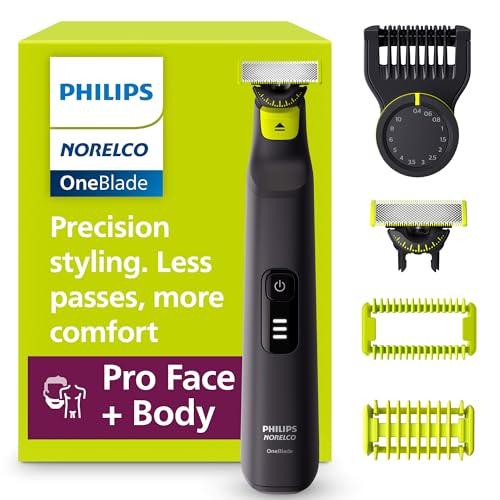
OneBlade Technology: Fast-moving cutter works 12,000x/min on longer hair; Dual Protection with glide coating and rounded tips supports comfortable grooming

One authentic Philips Norelco OneBlade stainless steel 360 blade lasts up to 4 months¹; trim, edge, and shave any length of hair, even the longest one

OneBlade Technology: Fast-moving cutter works 12,000x/min on longer hair; Dual Protection with glide coating and rounded tips supports comfortable grooming
Blade Performance and Shaving Precision
Beyond the pricing structure and feature packages lies a more fundamental consideration: how well each model actually performs during use. The OneBlade Pro delivers superior blade efficiency and precision trimming compared to the original model. You’ll notice the Pro’s articulating head provides enhanced maneuverability, allowing you to cut in multiple directions without repositioning. However, the straight blade design remains preferable for line work where stability prevents unwanted articulation.
Both models excel at creating crisp lines and near-skin shaves across various hair types. Yet you should know that tiny teeth on the blade struggle with thick hair and dull quickly during bulk removal. For handling thicker body hair more effectively, consider that adjustable guards on specialized grooming devices provide better control over cutting length in sensitive areas. Additionally, devices with IPX7 waterproof ratings allow for convenient rinsing and maintenance under running water. The Pro’s adjustable comb attachments give you better control over cutting length, making it the more versatile choice for precision grooming tasks. The dual-sided blade design accommodates sensitive skin while maintaining shaving effectiveness in multiple directions.

✅ Adjustable Function - Easily adjust the blade with 6 adjustable settings exposure by turning the knob below the razor head - Customize your shave by selecting your exposure of choice. The lower the setting, the less the blade exposure and the milder the shave. Find the setting that's just right for you

MULTIFUNCTIONAL SHAVING KIT FOR HEAD TO TOE USE - The all in one barber clippers include 7 trimmer heads, 10 hair combs and a base. Covers all hair cutting tasks, from hair, face, beard, nose, ear, body and pubic area. Surprise your husband or any special man in your life with the perfect gift.
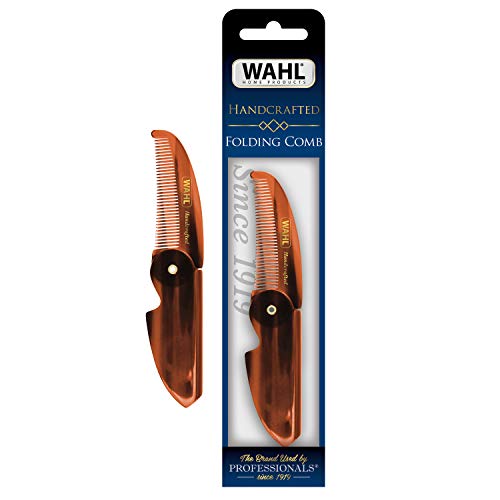
100% Handmade – Wahl’s folding comb is hand cut to gently stimulate natural oils on the head & face for healthy scalp & skin; smooth, rounded tips allow for gentle stimulation of hair follicles & help prevent ingrown hairs while giving you healthier, tangle-free hair
How Each Model Handles Curves and Tight Spots
When you’re maneuvering the contours of your face, the fundamental differences between these two shavers become immediately apparent. The standard OneBlade‘s inflexible blade head requires you to manually adjust positioning in tight spots like your jawline and chin, demanding multiple passes for even results. Its rigid design struggles with contour adaptability, particularly on pronounced curves.
The Pro’s 360 articulation automatically adapts to every facial contour, maintaining constant skin contact without manual repositioning. This superior contour adaptability delivers exceptional tight spot efficiency around your neck, cheeks, and jawline. You’ll need fewer strokes to achieve smooth results in confined areas. The interchangeable blade design allows you to easily switch between different blade types for optimal performance across various facial areas.
While the standard model works adequately on gentler curves, the Pro’s innovative design clearly excels where precision matters most. Its dual blade technologies help prevent nicks and bumps while maintaining visibility and control regardless of direction, making it the superior choice for demanding contours. Unlike corded-only razors such as the Philips Norelco 1100, the OneBlade Pro offers cordless flexibility while maintaining consistent cutting performance.

OneBlade Technology: Fast-moving cutter works 12,000x/min on longer hair; Dual Protection with glide coating and rounded tips supports comfortable grooming
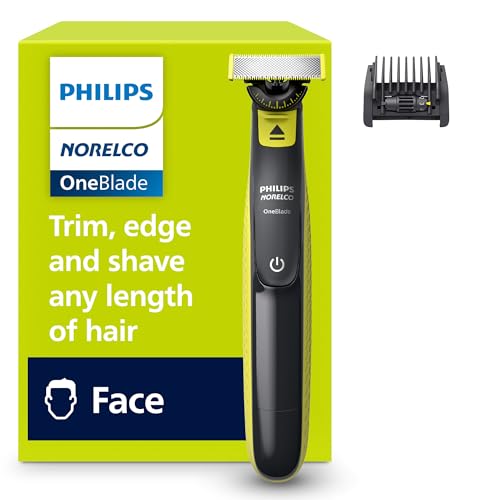
OneBlade Technology: Fast-moving cutter moves 12,000x/min on longer hair; the Dual Protection system with glide coating and rounded tips supports a more comfortable shave

The authentic genuine Philips OneBlade blades
Noise Levels: Which Model Runs Quieter?
How much difference does 5 decibels really make when you’re shaving? The Pro operates at 59 decibels versus the Standard’s 64 decibels—a measurable yet subtle gap. However, the noise comparison extends beyond raw numbers. The Standard produces a high-pitched, buzzy sound that lacks smooth frequency characteristics, while the Pro delivers a rounded, smooth audio profile free of harsh tones. User feedback consistently praises the Pro’s quiet operation, though one reviewer noted occasional rattling. The Standard’s noise could improve in pleasantness. Both models offer reasonable volume levels, but the Pro compensates for its marginal decibel advantage with superior sound quality, creating a noticeably more pleasant shaving experience despite the minimal numerical difference. Like other quality shavers, the Pro is designed to minimize irritation and deliver a close shave comparable to wet/dry use capabilities found in premium women’s razors. A quieter shaving experience can also contribute to improved hygiene by allowing users to focus on proper technique without distraction. It’s worth noting that blade performance impacts overall user satisfaction, as duller blades may require increased motor strain and produce additional noise during operation.
In the Box: Stand, Combs, and Storage
While sound quality matters during your shaving routine, what you’ll unpack before that first use equally shapes your overall experience. The stand comparison reveals a key differentiator: you’ll find the OneBlade Pro QP6651/30 includes a luxurious charging stand, while the standard OneBlade QP6551/30 requires cable charging only.
For storage, you’ll appreciate the pouch quality differences. The Pro model delivers a premium travel pouch for secure portability, whereas the standard version includes a basic storage pouch. The OneBlade Pro 360 QP6541/15 doesn’t include any carrying case.
Both models feature adjustable comb attachments spanning 0.4-10mm, plus a three-millimeter body trimmer. You’ll receive two replacement blades with protective caps regardless of model selection. The battery performance varies between models, with 2 hours of runtime provided by the premium options to power your grooming sessions. For seniors with limited dexterity or arthritis, these ergonomic features and ease of blade replacement become particularly important for maintaining grooming independence. These accessories create a cohesive grooming system aligned with each device’s functionality, offering the kind of zero-gapped precision that distinguishes quality grooming tools from basic alternatives.

Compatible with Philips 2000 Series Models: Only for QP2724 QP2834 QP2734 QP2824 One Blade 360 Four Models, Double-check your device model and plug shape before purchase, as incorrect use may harm your shaver

Customized for all handles for One Blade QP2520 / QP2530 / QP2620 / QP2630(Note: charging cable are not included)

Can be placed flat and attached to mirrors&smooth walls to take in your shaver.
Your Decision: Pro for Contours, Standard for Simplicity
Your choice between these models hinges on your facial topology and grooming priorities. If you’ve got pronounced curves, irregular contours, or difficult-to-reach areas, the Pro advantages justify the investment. Its 360 Blade maintains constant skin contact on complex facial surfaces, reducing irritation and passes needed. You’ll appreciate the multi-directional flexibility for precision edging on contoured skin.
Conversely, the Standard model delivers solid standard benefits if your face lacks extreme curves or you prefer uncomplicated routines. Its basic contour-following handles flat areas effectively without unnecessary complexity. You’ll appreciate the streamlined approach: fewer length settings, single comb design, and straightforward wet/dry operation. The waterproof design supports both wet and dry use, making it convenient for grooming at the sink or in the shower. A quality grooming routine can be more cost-effective than regular professional visits, which typically range from buzz cut pricing depending on your location. After shaving, consider daily moisturization with lightweight products to keep your skin healthy and comfortable.
Both share the 200x/second cutter speed and dual-sided blade. Your decision ultimately depends on whether you need advanced contouring capability or value simplicity and ease of use.