You’ll find safety razors easier to master quickly, with predictable blade costs around $18 annually. Straight razors demand significant skill but offer superior long-term value—you’ll save roughly $800 over 40 years without replacement expenses. If you’re committed to learning proper technique, straight razors deliver a closer shave and eliminate irritation entirely. Your choice hinges on whether you prioritize immediate convenience or long-term savings and craftsmanship. The specifics of mastering each method deserve deeper exploration.
How to Choose: Safety Razor vs. Straight Razor
How do you weigh the trade-offs between upfront costs and lifetime value? Your choice hinges on your priorities and commitment level.
Choose a safety razor if you’re beginning your shaving journey or prefer minimal blade maintenance. You’ll invest moderately upfront, then manage predictable blade replacement costs. The protective cap design eliminates technique demands, making your user experience straightforward and safe. Safety razors come in various styles, including open-comb models and adjustable options that cater to different skin types and shaving preferences. Safety razors also provide superior hygiene from easy cleaning and frequent blade changes compared to multi-blade systems.
Opt for a straight razor if you’re willing to master proper technique and handle honing every six to twelve months. You’ll face steeper initial costs and maintenance demands, but achieve superior shave quality and lowest lifetime expenses. Unlike safety razors, straight razors last a lifetime with one blade, providing exceptional long-term value for committed users.
Consider your skill level honestly. Beginners benefit from safety razors’ forgiving design. Experienced shavers valuing closest shaves justify straight razor investment and blade maintenance dedication.

German Design Adjustable Handle to set blade exposure levels from 1 to 6. Matte chrome plated over zinc.
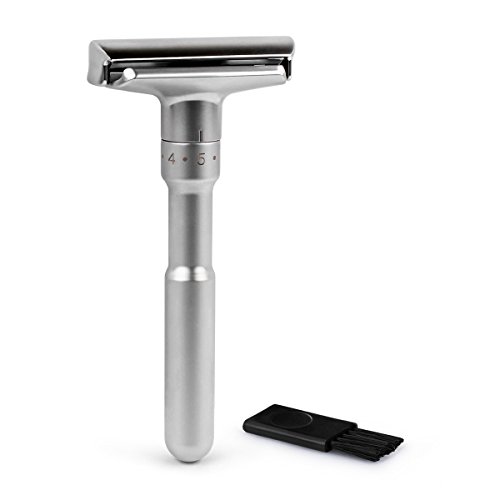
German Design Adjustable Handle to set blade exposure levels from 1 to 6. Matte chrome plated over zinc.

THE SMOOTHEST SHAVE for both men & women – Significantly reducing ingrown hair, skin irritations and razor burn often experienced with plastic cartridge razors, helping you finally achieve the smoothest, cleanest and closest shave.
Which Is Actually Safer and Easier?
When you’re deciding between safety and straight razors, the differences in injury risk and ease of use become immediately apparent. Safety razors win decisively on both fronts. Their protective guard substantially reduces serious lacerations, while straight razors demand considerable skill to avoid nicks and cuts. You’ll achieve acceptable results within days using a safety razor, whereas straight razors require extended practice for comfortable handling.
Regarding skin irritation, safety razors excel with single-blade technology that minimizes repeated stress on your skin. You’ll avoid the chemical exposure from synthetic glide strips found on cartridge alternatives. Safety razors with closed comb designs are particularly effective at controlling blade aggression and keeping blade edges away from skin. Straight razors can produce zero irritation once you’ve mastered technique, but that mastery takes time. For those with sensitive skin, options like aloe-infused non-irritating formulas provide additional protection during the shaving process. Unlike disposable cartridge razors that dominate the market due to corporate interests, straight and safety razors offer sustainable alternatives that benefit both your skin and the environment.
For most users, safety razors deliver superior safety and faster competency without sacrificing shave quality or skin health.

THE PERFECT SHAVE: Make skin irritations and ingrown hair a problem of the past. With the double sided razor, you will achieve the closest shave effortlessly.

CLEAN SHAVE: Traditional Wet shave is the secret of a clean shave. The close comb design provides gentle, close and smooth shave. It will eliminate the skin irritation. It's also perfect for bikini, underarm, facial and leg hair removal.

𝐋𝐎𝐍𝐆, 𝐊𝐍𝐔𝐑𝐋𝐄𝐃 𝐇𝐀𝐍𝐃𝐋𝐄: MERKUR 23C has a long, textured handle that provides a strong grip and excellent control, especially for someone with large hands. Its three-piece design offers easy cleaning and lasting durability. It's loved by millions and is one of our most popular single blade razors for men.
Do Straight Razors Really Shave Closer?
Do straight razors actually deliver a closer shave than safety razors, or is it mostly mythology? The answer lies in technique mastery and blade design. With proper honing and stropping, straight razors match or exceed safety razor closeness because their single, longer blade executes gentler first-pass shaves. You’ll experience less irritation and fewer ingrown hairs compared to multi-blade systems that tug and pull.
However, the closeness comparison isn’t purely about the tool—it’s about your skill. Both razor types achieve equally close results when you’ve developed proper technique. The real advantage? Straight razors maintain sharpness longer through stropping, delivering consistent closeness without blade replacement costs. Unlike safety razors, which feature a protective guard that reduces injury risk, straight razors require more skill but reward mastery with superior edge retention. You’re investing in a lifetime instrument that improves with practice. Unlike safety razors that require frequent blade changes, a straight razor can serve you for decades with proper maintenance and regular honing. The grind type of your straight razor also influences how effectively it maintains its edge between honing sessions.

Dual Grit Design (3000/8000) - Achieve razor-sharp precision with this two-sided whetstone: Use the 3000 grit for refining and the 8000 grit for ultra-fine polishing to restore a mirror finish on your blades

Professional Whetstone: 2 whetstones have difference grit which are 400/1000 and 3000/8000. The grit is accurate. 4 sides grit are satisfy with any knife blade needs. 400/1000 grit is typically used to repair knives with chipped edges and sharpen dull knives. 3000/8000 grit used to refine the edge and provide extra fine finish/polish on your blades.

The sharpening stone is suitable for any daily sharpening, such as repairing the knives with big cutting edges, and polishing the knives, the sharpening stone will help you to make the knives more smooth
How Long Does It Take to Master Each?
While straight razors can deliver superior closeness once you’ve mastered them, that mastery doesn’t happen overnight. Your learning timeline differs greatly depending on which razor you choose.
With a safety razor, you’ll achieve competent results within days or weeks. The protective guard reduces risk and psychological barriers, allowing you to focus on fundamentals like blade angle and pressure without steep demands. Taking time to prepare your skin properly, such as with a warm shower, helps optimize your results regardless of razor type. Maintaining the 30-degree angle consistently throughout your shave is one of the most critical skills to develop early in your practice.
Straight razors require weeks or months of consistent practice. You’ll master blade angle, shaving pressure, and whisker grain understanding—plus stropping and honing maintenance. This extended learning timeline demands patience and skill retention through repetitive practice sessions. However, straight razors can last a lifetime with proper care, making the investment worthwhile for committed users.
Safety razors suit beginners better, offering faster progression to competency. Straight razors transform shaving into a mindful ritual requiring sustained dedication before you’ll develop true mastery.

Perfect Holiday Gift For Men - Make any man extremely happy with Viking Revolution Safety Razor Shaving Kit. This luxury shaving kit for men is ideal as a gift for fathers, husbands, sons or any man for that matter.

COMPLETE MEN'S SHAVING KIT: The Gentleman Jon Shaving Kit for Men is a comprehensive set that includes a safety razor, badger hair brush, alum block, shave soap, stainless steel bowl, and five razor blades - everything needed for a luxurious, comfortable and smooth wet shave experience. With its compact design, our product is also a suitable travel companion to those who value traditional shaving, ensuring a neat shave even while on the go.

OUR 85MM SAFETY RAZOR - is made with solid brass and then chrome plated. The compact handle is shorter than most razors, giving you a better grip and more control when trimming your whiskers.
What’s the Real Long-Term Cost?
The upfront cost difference between straight and safety razors narrows dramatically once you’ve factored in lifetime expenses. Your initial investment analysis reveals that while straight razors cost $30–$110 upfront, they require no blade replacements ever. Safety razors demand $30–$50 initially, plus $18.25 annually for blades over 40 years.
The maintenance cost comparison favors straight razors long-term. You’ll spend roughly $196.47 on a safety razor setup versus $1,009 for cartridge systems over four decades. Straight razors cost even less because stropping and honing supplies represent minimal expenses compared to recurring blade purchases. With proper care, a straight razor can function flawlessly throughout your entire lifetime, eliminating the need for replacement investments. Safety razors with closed-comb designs offer forgiving construction that minimizes irritation while maintaining cost-effectiveness.
Both wet-shaving methods crush disposable razors economically. You’ll pocket $812+ switching from cartridges. Safety razors win on convenience, while straight razors deliver maximum savings.

【Complete Knife Sharpening Stone Kit】You don't need to be a Pro to sharpen your blades, all you need is the right tools & technique. All the sharpening tools you need are here, one affordable set for you: 400/1000 & 3000/8000 grit whetstone; Coarse flattening stone; Non-Slip Bamboo base; Knife sharpening angle guide; Leather strop, a simple instruction manual about how to use and what does every component do.

🔪【Professional Whetstone Set】We provide all the necessary knife sharpening tools you need, comes with high quality grit 180/320 400/1000 3000/8000 Whetstone, Flattening Stone, Bamboo base, Leather Block, Angle guide, Polishing compound, Leather strop, Silicone Holder, Honing Guide and Cut Resistant Gloves.

* This ergonomic designed Stainless Steel made sliding style straight CUT THROAT razor is very for you.