You’ll find safety razors superior across three critical dimensions. You’ll spend just $0.04–$0.05 per shave versus $0.76 with disposables, breaking even around 200 shaves. You’re eliminating microplastic contamination that contaminates 94% of U.S. tap water and poses serious health risks. You’re also reducing your environmental impact dramatically—disposables contribute 2 billion units annually to landfills while steel blades recycle indefinitely. Your choice ultimately depends on whether you prioritize long-term savings, skin health, or climate responsibility, though the specifics of each advantage warrant closer examination.
Environmental Impact: Why Disposables Damage the Planet More Than Safety Razors
When you toss a disposable razor after a handful of shaves, you’re contributing to a staggering waste problem: roughly 2 billion razors end up in U.S. landfills annually, with each person generating over 2,400 disposable razors—approximately 600 pounds of trash—throughout their lifetime. Each disposable generates 43 grams of CO2 per use, totaling 1.1 kilograms annually. The fused plastic and metal construction prevents recycling, forcing these items into landfills for 1,000 years of degradation. Rinsing disposables releases microplastics into waterways, contaminating 83% of global tap water supplies. Plastic pollution and environmental degradation accelerate through overseas manufacturing and shipping emissions. Like the durability advantages seen in long-term product design, safety razors demonstrate superior longevity compared to disposable alternatives. Many grooming tools, such as precision trimming devices, are engineered for durability and easy maintenance, reflecting the same sustainable design principles that make safety razors environmentally superior. In contrast, safety razors feature replaceable steel blades that can be easily separated from the handle and sent to recycling facilities. Safety razors eliminate these problems: their recyclable steel blades and durable handles enable local production, dramatically reducing your carbon footprint and landfill contribution.
Price Per Shave: How Safety Razors Save Money Over Time
While environmental benefits matter, your wallet speaks louder—and safety razors deliver substantial financial advantages that compound over time. Your cost per shave drops dramatically with safety razors: approximately $0.04-$0.05 per shave versus $0.76 for cartridge alternatives. This cost comparison becomes evident through shave frequency analysis. If you shave fifty times yearly, safety razors cost roughly $2-$2.50 annually after initial investment, whereas cartridges demand $120-$197. Your breakeven point arrives within 200 shaves or approximately 68 weeks. Long-term, you’ll realize $58.90 yearly savings. Over a five-year period, this translates to hundreds in cumulative savings. Safety razors achieve ten times lower blade costs than cartridges, making them the economically superior choice for financially conscious shavers. Models like the King C. Gillette Double Edge Safety Razor offer beginner-friendly precision while maintaining these impressive cost advantages. For those seeking maximum closeness rather than cost savings, electric shavers like foil shavers offer alternative grooming solutions with their own long-term maintenance considerations. A bamboo safety razor with initial blade investment costs approximately $38 in the first year, after which expenses drop significantly to just $10 annually for blade replacements.

THE PERFECT SHAVE: Make skin irritations and ingrown hair a problem of the past. With the safety razor for women, you will achieve the closest shave effortlessly.

THE PERFECT SHAVE: Make skin irritations and ingrown hair a problem of the past. With the metal razor, you will achieve the closest shave effortlessly.

THE PERFECT SHAVE: Make skin irritations and ingrown hair a problem of the past. With the double sided razor, you will achieve the closest shave effortlessly.
The Hidden Health Cost: Microplastics and Waterway Contamination
Beyond the financial savings, you’re avoiding a significant health risk that disposable razors amplify through their plastic composition and disposal patterns. When you discard plastic razors, they fragment into microplastics that enter waterways via stormwater and sewage systems. You’re then exposed through drinking water—94% of U.S. tap water contains plastic particles—and seafood bioaccumulation from aquatic food chains. The health implications are substantial: microplastics concentrate in your bloodstream, bones, brain, and reproductive system. These particles carry up to 16,000 additive chemicals, with 25% classified hazardous. Research has linked microplastics exposure to serious health issues such as cancer, infertility, and Parkinson’s disease. For precise grooming alternatives, safety razors with ergonomic design and replaceable metal blades deliver the same control as disposable options while maintaining durability. Safety razors with replaceable metal blades offer the same precision and control as disposable options while maintaining the low-maintenance appeal that makes buzz cuts and other short styles so practical for daily grooming. By switching to safety razors with replaceable metal blades, you eliminate this contamination pathway entirely, protecting both your personal health and environmental water systems from persistent plastic accumulation.
Durability: Steel Reusability vs. Plastic Disposal
The longevity gap between safety razors and disposables represents a 100-fold difference in service life. Your stainless steel safety razor handle withstands decades of use, while plastic disposables fail within 5–10 shaves due to structural degradation under repeated torque and moisture exposure.
Handle materials fundamentally determine longevity. Stainless steel offers indefinite corrosion resistance; brass and titanium variants provide superior strength-to-weight ratios. Conversely, plastic components crack under mechanical stress and become brittle within months during storage. Safety razors also deliver closer shaves through their single sharp blade design, which contributes to their overall superiority in performance and longevity compared to multi-blade disposable systems.
The longevity comparison is stark: you’ll replace disposables weekly, while properly maintained safety razors perform reliably for 50+ years. Vintage razors from the 1950s remain functional today, proving that metal construction enables multi-generational reusability. Your safety razor’s threads and components show minimal wear even after decades of daily use, rendering plastic’s planned obsolescence obsolete. With regular maintenance including weekly cleaning and proper drying to remove moisture, safety razor handles can achieve lifetimes of durability far exceeding any disposable alternative.

THE PERFECT SHAVE: Make skin irritations and ingrown hair a problem of the past. With the eco safety razor, you will achieve the closest shave effortlessly.
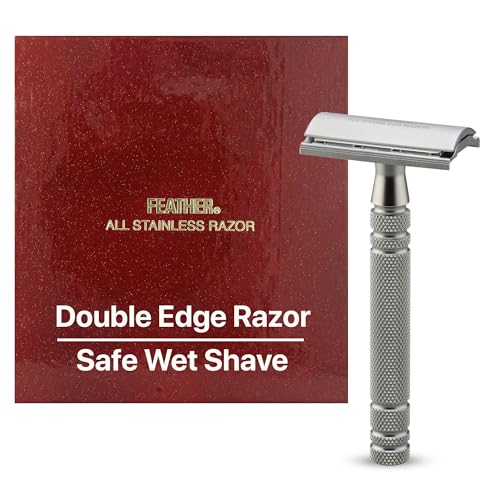
LUXURIOUS DESIGN - The Feather All Stainless Double Edge Razor AS-D2 showcases a luxurious design, combining elegance with functionality. Its Japanese engineered three piece stainless steel construction ensures easy dismantling and cleaning for a more convenient shaving experience anytime.

THE SMOOTHEST SHAVE for both men & women – Significantly reducing ingrown hair, skin irritations and razor burn often experienced with plastic cartridge razors, helping you finally achieve the smoothest, cleanest and closest shave.
Safety Razors vs Disposables: Choose by Cost, Health, or Climate Impact
Because durability alone doesn’t determine value, you’ll want to evaluate safety razors against disposables across three critical dimensions: cost, health outcomes, and environmental impact.
Financially, safety razors deliver superior long-term savings. You’ll break even after 200 shaves—roughly 68 weeks—then spend just $10 yearly versus $120 for cartridge subscriptions. Safety razor benefits compound over decades as your reusable handle lasts a lifetime. Most quality safety razors can last 5-10 years or longer, making them a durable investment compared to disposables that require constant replacement. Popular models like the Merkur 34C combine affordability with reliable performance for everyday users.
Health-wise, disposable drawbacks emerge through frequent blade dulling, causing irritation and razor burn. Safety razors’ sharper single blades reduce skin trauma and suit even unsteady hands through secure design. Features like closed-comb designs provide additional forgiveness for sensitive skin and beginners.
Environmentally, disposables create billions of plastic-laden units annually in landfills. Safety razors minimize waste through metal reusability and lower manufacturing carbon footprints.
Choose safety razors if cost efficiency, skin health, and sustainability matter to you.

Model Number: ASTRA01


Sharp and precise – These double edge razor blades are designed to be sharp and precise to provide you with the ultimate shaving experience. Say goodbye to ingrown hairs, irritation and razor bumps thanks to these safety razor blades.