
You’ll achieve a comparable or superior closeness with a safety razor’s single-blade design, which cuts hair cleanly at skin level without tugging. A 30-degree blade angle and minimal pressure optimize results, while the guard mechanism reduces friction and irritation compared to multi-blade cartridges. Research demonstrates that safety razors deliver equivalent shave quality with considerably less skin trauma—40% versus 60% impact. Understanding the precise technique and maintenance requirements reveals why many users prefer this approach for sustained closeness and skin health.
How Safety Razors Cut Hair Differently
Whether you’re switching from a multi-blade cartridge or curious about what sets safety razors apart, understanding the mechanics reveals why they’re fundamentally different tools.
Safety razors employ a single-blade cutting action that severs hair at skin level without pulling. This contrasts sharply with multi-blade systems, where the first blade tugs hair upward and subsequent blades cut the extended shaft beneath the skin surface. You’ll experience no dragging or tugging because the guard mechanism controls blade exposure and maintains consistent angle throughout your stroke.
The hair dynamics differ critically: safety razors eliminate the snap-back effect that occurs when stretched hair retracts below the epidermis. Instead, you achieve one clean severance per pass, minimizing trauma and reducing friction at the blade-skin interface. This single-pass mechanism delivers a fundamentally different cutting experience than multi-blade designs. The reduced irritation from safety razors also means fewer cases of ingrown hairs compared to cartridge systems. To further reduce irritation and ingrown hairs, proper skin preparation and exfoliation before shaving helps remove dead skin cells and optimize results. The metal guard between the blade and skin not only enhances safety during shaving but also guides the blade angle for precision cuts that respect skin integrity.

THE PERFECT SHAVE: Make skin irritations and ingrown hair a problem of the past. With the safety razor for women, you will achieve the closest shave effortlessly.

THE PERFECT SHAVE: Make skin irritations and ingrown hair a problem of the past. With the double sided razor, you will achieve the closest shave effortlessly.

Smooth, Close Shave for Men & Women – Engineered as a single blade razor for men and women, it minimizes ingrown hairs and irritation. Experience a superior shave with this classic safety razor.
Blade Positioning: Why Precision Matters
Since even minute misalignments degrade shaving performance, blade positioning directly determines whether you’ll achieve the closer shave that safety razors promise. Precise blade alignment minimizes play during assembly, ensuring consistent contact with your skin. You’ll notice that razors with machined pins toleranced to 0.002 inches deliver superior results compared to looser designs requiring manual adjustment.
Exposure levels critically influence cutting efficiency. Neutral exposure balances performance for most users, while positive exposure increases aggressiveness for coarse beards. Conversely, negative exposure reduces irritation for sensitive skin. Your shaving results depend on how these positioning variables interact with blade gap and your technique. Maintaining a 30-degree blade angle during your shave complements proper blade positioning to optimize closeness and comfort. Regular inspection before shaving enhances the overall experience and safety by catching any alignment issues early. Premium razors eliminate guesswork through superior mechanical precision, allowing you to focus entirely on proper technique rather than compensating for alignment deficiencies.
Do Safety Razors Actually Shave Closer?
How much closer does a safety razor actually shave compared to cartridge alternatives? User tests demonstrate that safety razors achieve comparable or superior closeness through their single-blade design and precise blade exposure. While cartridges remove more stubble on the first pass, safety razors equalize results by the second pass without inducing skin sensitivity issues.
The key advantage lies in reduced irritation. You’ll experience fewer ingrown hairs and less razor burn with safety razors, enabling multiple passes for closer cuts. Cartridge razors’ multi-blade design increases skin contact, limiting sustained closeness and compromising skin sensitivity over time. Safety razor handles are also universally compatible across blade brands, allowing for customizable blade selection tailored to your specific skin and hair types. Models with longer handles excel for reaching difficult areas, while shorter-handle options provide control for contoured spots like knees and armpits. For those seeking the closest possible shave, bare blade cutting to minimal lengths offers precision comparable to professional grooming tools.
With proper angle maintenance and light pressure, you’ll achieve smoother results matching or exceeding cartridge performance while maintaining superior skin health throughout your shaving routine.

THE SHAVE OF YOUR LIFE - Crafted in Solingen, Germany, a city renowned for fine blade production, our stainless-steel, non-stick coated safety blades offer unrivaled precision and glide, giving you the cleanest and closest shave you've ever had

Model Number: ASTRA01

Sharp and precise – These double edge razor blades are designed to be sharp and precise to provide you with the ultimate shaving experience. Say goodbye to ingrown hairs, irritation and razor bumps thanks to these safety razor blades.
Safety Razor vs. Cartridge: What Research Shows
When you’re comparing safety razors to cartridge alternatives, the evidence reveals distinct mechanical and physiological differences that affect shave quality and skin health. The Leaf Shave study, which tracked 30 participants across 12 weeks comparing DE razors, triple-blade, and plastic cartridges, demonstrated measurable safety benefits favoring single-blade designs. You’ll find that DE razors cut hair cleanly without the tugging action inherent to multi-blade cartridges. This distinction directly addresses irritation factors—cartridges’ repeated blade passes increase razor burn risk and ingrown hair development, particularly for sensitive skin. Meanwhile, safety razors’ single-pass cutting mechanism minimizes skin trauma. For those with extremely sensitive skin, options like the Flamingo 5-Blade Razor and safety razors such as the Rockwell 6S offer tailored solutions that balance closeness with dermatological comfort. Mild, adjustable safety razors with flippable base plates provide additional versatility for users seeking to customize their shave aggression. Though cartridges offer convenience and require less technique mastery, the clinical data supports DE razors’ superior performance regarding both shave closeness and dermatological outcomes. The initial investment for a DE shaving kit typically ranges from $50 to $100, but the long-term cost savings and reduced plastic waste make this traditional method an economically and environmentally responsible choice compared to expensive cartridge replacement cycles.

THE PERFECT SHAVE: Make skin irritations and ingrown hair a problem of the past. With the metal razor, you will achieve the closest shave effortlessly.

THE SMOOTHEST SHAVE for both men & women – Significantly reducing ingrown hair, skin irritations and razor burn often experienced with plastic cartridge razors, helping you finally achieve the smoothest, cleanest and closest shave.

THE SMOOTHEST SHAVE for both men & women – Significantly reducing ingrown hair, skin irritations and razor burn often experienced with plastic cartridge razors, helping you finally achieve the smoothest, cleanest and closest shave.
The Right Pressure and Angle for Closeness
While research demonstrates that DE razors outperform cartridges in shave quality, achieving that superior closeness depends entirely on proper technique—specifically the angle and pressure you apply. You’ll find the ideal angle falls between 30°–45°, where you position the blade by riding the cap on your skin and adjusting until you feel stubble removal. This angle adjustment directly influences cutting efficiency and closeness. For pressure control, apply only the razor’s weight without pressing into your skin; let gravity and blade sharpness do the work. The safety bar should rest lightly against the skin to ensure you’re maintaining optimal pressure throughout your shave. Like professional grooming tools with self-sharpening high-carbon steel blades, safety razors require proper maintenance to sustain their cutting performance. You can refine closeness further by pulling skin taut on delicate areas and using short strokes with the grain. Additionally, safety razors reduce skin irritation and ingrown hairs when technique is properly executed compared to multi-blade alternatives. Mastering these fundamentals transforms your shave quality dramatically.

Single edge: extremely sharp for fast, efficient cutting

Sharp, high-quality steel for strength and durability that holds an edge through multiple uses. Durability for repetitive scraping and cutting tasks

Treet Carbon Steel Razor Blades
Master Your Shaving Technique in 3 Steps
First, hydrate your face with warm water for three minutes, then apply face-specific cleanser. Build lather by swirling your brush in cream for 30-60 seconds, achieving proper consistency that lifts hair. For optimal results, use a shaving cream in a tube rather than aerosol cans due to superior fat content and skin protection. Consider brands with proven reliability like Wahl, Philips, and Remington for consistent quality across grooming products.
Second, execute your shaving techniques systematically. Perform your initial pass with the grain using gravity—not pressure. Follow with perpendicular passes across the grain. Use short, slow strokes perpendicular to the blade edge to minimize cutting risk and improve quality.
Third, rinse your blade after each side to remove buildup, maintaining ideal blade care. Close pores with cold water post-shave, then apply moisturizer to sensitive areas.
Why Your Skin Will Feel Better
Because safety razors rely on a single blade rather than multiple stacked blades, your skin experiences markedly less trauma during each stroke. A single blade stresses your skin once per pass, whereas cartridge razors cause repeated trauma that accumulates skin irritation.
You’ll notice reduced tugging and pulling, which minimizes razor burn and ingrown hairs. The sharp blade glides cleanly without requiring excessive pressure, delivering a comfortable shave that’s particularly beneficial for sensitive skin. Research using multispectral near infrared spectroscopy has confirmed that this gentler approach reduces measurable skin redness immediately after shaving.
Your post-shave recovery accelerates noticeably. Redness dissipates faster because your skin endures minimal stress. Studies demonstrate that safety razors produce 40% skin impact compared to cartridge razors’ 60%, meaning your skin recovers quicker and feels considerably better overall. This reduced inflammation translates to smoother, healthier-looking skin with fewer nicks and irritation issues. For those with particularly sensitive skin prone to pseudofolliculitis, using quality post-shave care such as balms and astringents can further enhance recovery and comfort. Maintaining sharp blades through frequent replacement ensures optimal performance and continued skin protection.
How Long Before You See Real Results?
Now that you’ve experienced the immediate skin benefits of safety razors, you’ll want to understand the timeline for achieving ideal shave closeness.
Your adjustment timeline spans several weeks of consistent practice. Initial shaves reveal a learning curve where you’ll need multiple passes for smooth results. Proficiency typically reduces shaving time to 12 minutes per session as you refine technique and blade angle.
Progress indicators emerge gradually. You’ll notice reduced nicks and razor burn within days, while closeness improves considerably after one to two weeks. Your skin adjusts simultaneously, enhancing the razor’s effectiveness. Beginners may experience a higher frequency of blade replacement during this initial adjustment period, but replacement frequency will stabilize as proper shaving technique is developed.
Experimentation during this period helps you identify your best blade match, such as Feather blades for the closest shave or alternatives like Astra Superior Platinum that suit your specific hair type and skin sensitivity. Consistent routine execution yields measurable improvements in shave quality and skin comfort, establishing sustainable results that justify your change to safety razors.
Keep Your Blade Sharp: A Maintenance Guide
Maintaining your safety razor’s sharpness directly determines the quality of your shaves and the longevity of your investment. Effective blade care requires changing your blade every 3-5 shaves for daily users or 5-7 shaves for infrequent shavers. After each use, rinse your blade thoroughly with warm water and pat it completely dry to prevent rust formation. You’ll avoid dulling by never tapping or dropping your razor. Establish maintenance frequency by conducting regular rinse-and-dry cycles after every shave session and performing deep cleaning monthly or when mineral buildup appears. For hard water users, weekly cleaning prevents deposit accumulation that compromises blade performance. While safety razors can deliver results comparable to electric alternatives like foil shavers, their closeness depends entirely on blade condition and proper maintenance. Watch for signs of dullness like increased tugging or irritation, which indicate it’s time for a fresh blade. Store blades separately during extended storage periods to eliminate moisture-related corrosion. Use a soft toothbrush with mild dish soap to remove stubborn deposits that accumulate on the blade and razor head over time.

Sharp and precise – These double edge razor blades are designed to be sharp and precise to provide you with the ultimate shaving experience. Say goodbye to ingrown hairs, irritation and razor bumps thanks to these safety razor blades.

Sharp and Precise- Highest quality edging blades for a precise and clean shave.
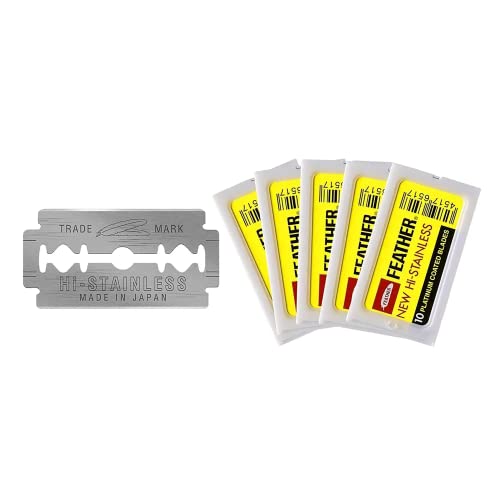
Fifty Count Of Double Edge Razor Blades; Our Razors For Men Feature A Fifty Count Of Double Edge Razor Blades; Feather Razor Blades Are Extremely Sharp And Will Give You A Great Shaving Experience
What You’ll Actually Spend Over Time
While proper blade maintenance extends your razor’s lifespan, the real financial advantage of safety razors emerges over months and years of regular use. Your initial investment of $50–$110 establishes a higher entry point than cartridge systems at $22.50. However, annual blade costs drop dramatically: safety razors cost $3.64–$10 yearly versus $25–$120 for cartridges. This cost comparison yields significant long term savings. By year two, you’ll recoup your investment. Over 40 years, you’ll spend approximately $196.47 total with a safety razor compared to $1,009 with disposables—a $812.53 difference. Your safety razor handle lasts 10–50 years, making it economically superior despite higher upfront expenses. Regular maintenance, including consistent blade cleaning and oiling, ensures optimal performance and extends blade longevity. For beginners, entry-level options like the Merkur 34C provide an affordable way to start experiencing these long-term financial benefits. Safety razor blades are also recyclable materials, which adds environmental value beyond the financial savings.