You’ll find clipper guard numbers ranging from 0 to 8, each representing hair length in eighths of an inch. Lower numbers create shorter cuts—#0 delivers skin fades while #1 offers a 1/8-inch buzz. Higher guards like #6 or #7 leave longer hair for styling flexibility. Match guards to your hair type: thin hair benefits from #2 or #3, while thicker hair accommodates higher numbers. Beginners should start with #3 or #4 to avoid irreversible mistakes. Understanding guard variations across brands and proper lever adjustments transforms your cutting technique greatly.
What Clipper Guard Numbers Actually Mean
If you’ve ever wondered why your barber asks “what guard do you want?”, it’s because clipper guard numbers are the universal language for hair length. Understanding clipper guard basics helps you communicate precisely with your stylist and achieve your desired cut.
Guard numbers range from 0 to 8, with each representing a specific hair length measured in eighths of an inch. Lower numbers produce shorter cuts—#0 gives you a skin fade, while #1 delivers a very short buzz at 1/8 inch. Higher numbers leave progressively longer hair, with #8 reaching approximately one inch. A clipper size 2 or below is typically considered a short haircut suitable for low-maintenance styles like buzz cuts and crew cuts. For precise results, many professionals recommend using quality blade trimmers that maintain consistent cutting performance across different guard lengths. To maintain optimal performance and achieve clean, precise cuts, it’s important to clean guards thoroughly after each use to remove hair debris and ensure the trimmer operates at peak efficiency.
Guard number variations exist across brands, so lengths may differ slightly depending on your clipper manufacturer. Always reference your specific brand’s chart and discuss your target length with your stylist for best results.

High Quality: Constructed from robust ABS material. Flexible and sturdy like the original.

Color Coded: Each guards with a different color and different cutting lengths. Grab quickly based on the identity of color. Please note that the color are randomly assigned.

Precise Long Haircuts: Includes 1-1/4" (#10) and 1-1/2" (#12) attachment guards, crafted with precision, these guards maintain consistent cutting lengths - ideal for achieving tailored, longer hairstyles at home with ease.
Matching Guard Sizes to Hair Type and Density
For thin hair, you’ll want guards #2 or #3 to minimize scalp visibility while maintaining manageable length. Thicker hair accommodates higher numbers like #6 or #7, providing structure and styling flexibility. Curly and textured hair benefits from shorter lengths—guards #1 or #2—that enhance curl definition and prevent matting. Curly hair shrinks after cutting, so you may need to adjust your guard choice upward to achieve your desired final length.
Guard compatibility extends beyond single numbers. Barbers often combine multiple guard heights across different scalp regions to address varying density distribution. This strategic approach balances your head shape, hair type, and desired aesthetic. To maintain your trimmed beard between appointments, incorporate regular brushing and combing into your grooming routine to distribute natural oils and keep your beard looking sharp. Proper maintenance also requires 70% isopropyl alcohol to disinfect your clippers after each use and prevent bacterial buildup. Consulting with your barber helps assess your specific density patterns and guarantees ideal guard selection for your unique hair characteristics.
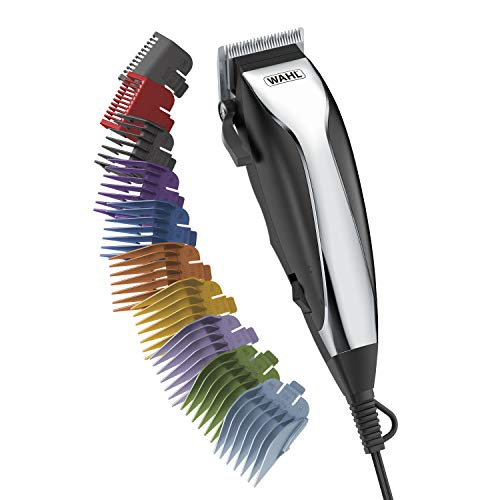
Multi-Cut Hair Clipper - Heavy duty motor for exceptional power and no-snag cutting; features an adjustable taper lever for easy blending and fading. This results in a very strong audible hum, but is completely normal to its operation. Don’t settle for a weak clipper.

Hair Clipper Companion – Wahl’s Secure-Snap guide combs with colored metal clips are an upgrade to your existing hair clipper guide combs; Organizer conveniently and hygienically stores all the included hair clipper guards

Cordless Convenience – Color Pro Cordless is rechargeable and wireless. Cord/Cordless allows you to use the clipper on battery or when it's charging.
Guard Sizes for Popular Haircut Styles
Guard selection becomes straightforward once you’ve identified your desired style, as each popular haircut relies on specific guard combinations to achieve its signature look.
For buzz cut techniques, you’ll use uniform lengths ranging from #1 to #4 guards throughout. The #2 guard creates the traditional quarter-inch buzz cut, while #3 offers a longer alternative.
Crew cut variations require more precision. You’ll pair a #7 guard on top with #1 or #2 guards on the sides and back, creating that characteristic short-to-longer contrast. The #4 guard enters crew cut territory at half-inch length.
Fades demand gradual shifts using multiple guards—typically #1.5 blending to #3. Remember that the taper lever allows you to adjust the cut closeness between guard lengths for smoother transitions. For intricate fade work, professional-grade trimmers with magnetic guards provide superior control and consistency in blending between guard sizes. Wahl professional models like the 5-Star Magic Clip excel at creating precise fades with their staggered blade technology. Undercuts contrast disconnected tops with short sides using #3-#5 guards. Textured crops combine #1.5, #3, #5, and #8 guards strategically for movement and texture while maintaining overall shortness.

ULTRA-CLOSE CUT – without causing any irritation or discomfort

【HIGH QUALITY MATERIAL】Made of high-quality ABS & metal materials, durable and easy to clean, moderate hardness, giving you maximum protection, perfectly fit, easy to snap and remove, durable

High-Grade Nylon Build: Crafted from durable, flexible nylon designed to withstand daily use while providing a smooth, comfortable glide equal to original guards.
Why Starting Longer Prevents Permanent Damage
Once you’ve selected your desired style, you’re tempted to jump straight to shorter guards for efficiency, but this approach risks irreversible mistakes that’ll plague you for weeks. Starting with longer guards like #3 or #4 preserves critical guard retention, allowing you to fade progressively downward without over-cutting. This strategy prevents permanent damage by maintaining blendable length throughout your cut.
Short guards demand precise technique; errors produce bald patches requiring 2–4 months of regrowth. By beginning longer, you retain optionality for style adjustments and corrections if needed. Hair regrows roughly half an inch monthly, so avoiding mishaps on your first pass saves considerable time. Longer starts also reduce motor strain on overgrown hair, preventing snagging that causes uneven results. For those with sensitive skin, selecting a trimmer with a powerful motor like the Brio Beardscape V2 helps maintain consistent performance without bogging down during longer guard passes. Using pre-shave oils before trimming can further improve glide and reduce irritation during your cut. Trimming against the grain offers a closer cut and requires more skill, making it especially important to build confidence with longer guards first. This conservative approach minimizes regret while protecting your appearance.
Building Clipper Guard Fades From Bottom to Top
Since mastering the foundational technique of starting longer prevents costly mistakes, you’re now ready to execute the strategic progression that transforms a basic trim into a polished fade. You’ll divide the fade into three blending zones: bottom (skin to #1), middle (#1 to #2), and upper blend (#2 to top). Begin with your guard progression using no guard closed, then advance through #0, #1, and #1.5 guards in closed positions. Employ lever techniques strategically—fully open for longer blends, halfway closed for mid-level shifts, and fully closed for tight cuts near the scalp. The adjustable lever feature on professional clippers allows you to soften harsh lines between guard transitions for seamless blending. Apply scooping “C” motions upward to eliminate harsh demarcation lines. For optimal results with challenging hair types, consider tools with high-speed motors similar to professional-grade equipment that maintain consistent cutting power throughout your fade. Perform symmetry checks from multiple angles, then mirror the entire process on the opposite side for balanced cutting motions and professional results.
Half-Guards and Lever Adjustments for Blending
To achieve seamless changes between guard lengths, you’ll leverage your clipper’s taper lever—a mechanism that adjusts the top blade’s position relative to the stationary bottom blade, effectively creating half-guard increments without swapping guards.
Understanding lever functionality is essential for precision blending. When you close the lever (down position), you add approximately 1/16 inch to your guard length, mimicking a half-guard effect. Opening the lever (up position) cuts at exact guard length, allowing you to shift smoothly between sizes like #3 to #2. For those seeking advanced trimming capabilities, devices with integrated zoom wheels offer multiple length settings that complement lever adjustments. Quality trimmers with sharp rotary or linear blades provide cleaner cuts that make blending transitions more seamless and professional-looking.
Your blending techniques improve dramatically with this tool. Position the lever up on lower guard sections to leave more hair, then adjust downward as you work higher on the fade. This instant adjustment capability eliminates guard-swapping delays while delivering professional results. Consistent lever positioning throughout your cut prevents uneven cutting length and ensures uniform transitions across the fade.
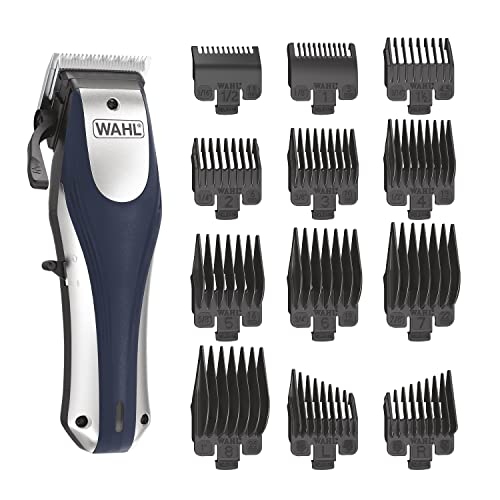
Cordless Operation – The power of a corded hair clipper with the convenience of a cordless; to use simply plug the clipper into charge and unplug when ready to use with cordless convenience

15-in-1 Complete Haircut Kit: Everything you need is included: 1×hair clippers, 8×Color-Coded Guards, 1×hair cutting cape, 1×storage pouch, 1×brush, 1×USB charging cable, 1×styling comb, and 1×oil bottle. The hangable design with built-in hole offers convenient wall or hook storage to save space

Heavy Duty Motor – Our ultra-power heavy duty hair trimming system easily cuts the thickest hair with 35 percent more power than standard Wahl electromagnetic motor clippers, This results in a very strong audible hum, but is completely normal to its operation. Don’t settle for a weak clipper.
Five Common Guard Selection Mistakes
Even with quality clippers and proper lever technique, you’ll undermine your results if you’re selecting the wrong guard size. The most common guard mistakes stem from choosing guards that are too small, ignoring your skill level, and mismatching guards to your style goals. You’ll also compromise results by not securing guards properly before cutting or using incorrect cutting directions. Beginners should start with larger guards like #3 (9mm) or #4 (12mm) rather than #0 or #1, which create excessive stubble. Understanding guard lengths prevents irreversible errors—remember that it’s easier to cut more hair later than fix an overly short cut. Magnetic or locking features on your guard attachment mechanism will ensure consistent performance and prevent slippage during your haircut. Always snap your guard securely into place and cut against hair growth for uniform results. While clippers handle bulk hair removal, trimmers excel at detailed finishing work around the edges and hairline for a polished final look. Just as proper stroking technique matters in straight razor shaving, maintaining a consistent cutting angle with your clippers ensures even coverage across all areas of the head.
Guard Numbers Vary by Clipper Brand: Here’s How to Adapt
You’ll find that the clipper industry maintains a standardized numbering system across all major professional brands, which means you don’t need to worry about learning different guard sizes depending on the manufacturer you choose. A number 2 guard consistently delivers 1/4 inch cuts regardless of brand, eliminating confusion about brand variations.
However, compatibility issues arise when you mix guards and clippers from different manufacturers. Guards attach to specific clipper models, so you can’t assume universal interchangeability. Before purchasing replacement guards, verify your clipper’s attachment system matches the guard design. The taper lever mechanism allows for smoother blending and shorter or longer hair depending on the setting, providing an additional layer of customization beyond the guard number alone. Similar to how pubic hair textures vary from curly to straight based on follicle shape and individual characteristics, clipper guard results can vary based on hair type and blade condition. Just as wet shaving capability enhances comfort and performance on compatible devices, using properly matched guards ensures optimal cutting results and prevents damage to your clippers.
Some European brands introduce specialty half-size options like 1.5 guards, creating minor brand variations beyond the standard 0-8 range. Research your specific model to confirm proper fit and ideal cutting performance, preventing uneven results and blade attachment problems.

【Complete Set for Versatile Styling】 This clipper guard kit includes 10 colorful guide combs in full sizes (1.5mm, 3mm, 4.5mm, 6mm, 10mm, 13mm, 16mm, 19mm, 22mm, 25mm) to meet a wide range of haircut lengths, from precise trims to longer cuts. It also comes with 2 black ear taper combs (left & right) for clean edging around the ears. The set is equipped with a cleaning brush, blade oil, and a convenient storage case, making organization and maintenance easy. Multiple size options allow you to achieve buzz cuts, fades, layered trims, and various hair lengths with confidence.

High Quality: Constructed from robust nylon material. Flexible and sturdy like the original.

High Quality: Constructed from robust nylon material. Flexible and sturdy like the original.