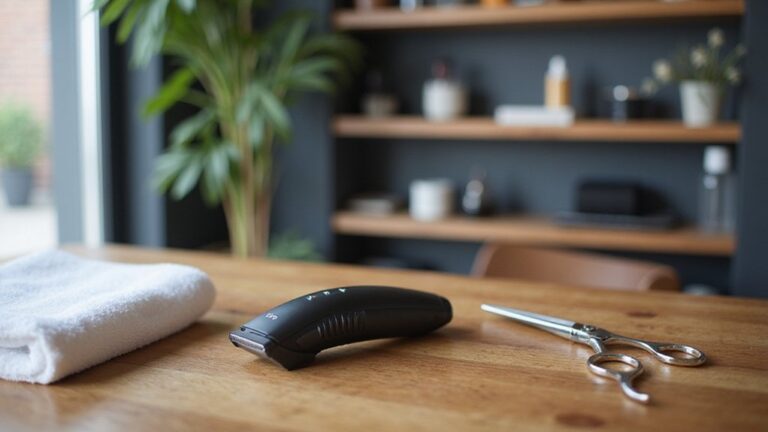
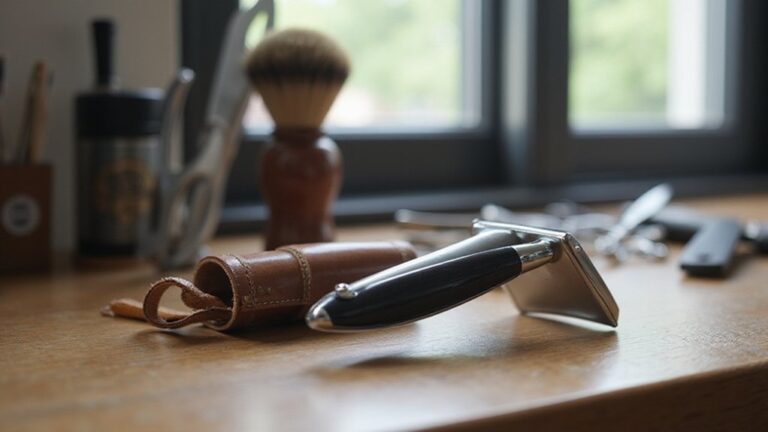
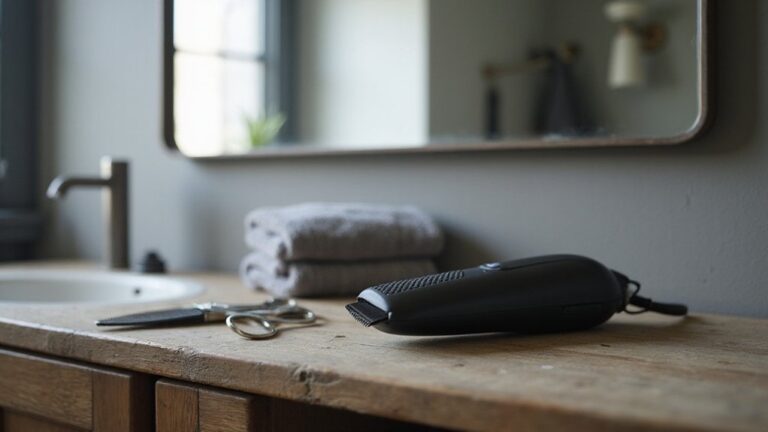
You’ll need both tools for professional results. Clippers handle bulk hair removal using wide blades and various guard sizes, while trimmers excel at precision edging with narrow, sharp blades in tight spaces. Start with clippers for foundational cuts, then finish with trimmers on sideburns, hairline, and nape for polished details. Combining these techniques creates seamless fades and clean edges that separate amateur cuts from salon-quality work. Understanding when to deploy each tool’s unique strengths will transform your grooming game.
What’s the Real Difference Between Clippers and Trimmers?
Why do you need both clippers and trimmers when they seem to do the same job? They’re fundamentally different tools designed for distinct purposes.
Clippers feature powerful motors and heavy-duty construction that deliver clippers durability for bulk cutting through thick, coarse hair. You’ll use them for large sections, fades, and base cuts that require substantial power.
Trimmers, conversely, excel at precision work. Their lightweight design lets you navigate tight spaces and delicate areas like hairlines, necklines, and sideburns with accuracy. They cut closer to skin for clean edges that clippers can’t achieve. Shorter and finer blades enable trimmers to perform detailed grooming tasks that would be impossible with standard clippers. Professional trimmers often feature T-blades specifically designed for precision edging and clean lines. When selecting a trimmer, consider key factors like cutting power and battery life to ensure optimal performance for your grooming needs.
Regarding trimmers maintenance, their simpler construction requires minimal upkeep compared to clippers’ multiple guards and attachments. You’ll invest in clippers for foundational work and trimmers for finishing touches that transform a haircut from basic to polished.
Blade Design: How Clippers and Trimmers Cut Differently
While clippers and trimmers serve similar functions, their blade designs differ fundamentally in ways that directly impact cutting performance and precision.
Blade widths vary greatly between the two tools. Clippers feature wide blades that excel at covering larger areas quickly during bulk removal, like cutting bald fades efficiently. Trimmers use narrow blades designed for precision outlining of beards and sideburns where accuracy matters most. Taper blades on trimmers are characterized by an angled shape that creates seamless blending and fading between different hair lengths.
Tooth patterns also distinguish these tools. Clippers typically have standard blades suitable for all hair types, while trimmers offer fine tooth blades for smooth finishes on sensitive skin. For coarse hair, deep tooth blades on trimmers provide aggressive cutting power. Professional-grade clippers like those from Andis deliver strong magnetic motors that power through various hair textures with consistent performance. Maintaining sharp blades through regular cleaning and maintenance ensures optimal cutting performance and reduces tugging or irritation during grooming. Understanding these blade design differences helps you select the right tool for your specific grooming task.
Why Clipper Guards Give You More Cutting Options
Clipper guards provide you with an extensive range of cutting lengths without requiring multiple tools or frequent blade changes. You’ll find standardized numbering from #0.5 to #8, each corresponding to precise inch measurements—#1 equals 1/8 inch, #2 equals 1/4 inch, progressing to #8 at one full inch.
This standardization guarantees consistency regardless of clipper brand or location. You can execute diverse cutting techniques using strategic guard progression. Fade cuts employ sequential guards for blended shifts, while crew cuts combine longer tops with shorter sides for definition. Textured styles vary heights across sections, and undercuts use extreme contrasts between disconnected lengths. Magnetic guards offer superior stability and secure attachment, making them favored for detailed and precision work. For professional barbers seeking even sharper results, zero gap trimmers provide an alternative option for executing the most precise line work and detailing.
Additionally, adjustable levers create 1/16-inch modifications between closed and open positions, enabling fine-tuning without swapping guards. This versatility accommodates different hair types and density requirements, eliminating the need for separate specialized tools. Professional-grade clippers like the Wahl Magic Clip feature powerful motors that maintain consistent performance across varying hair densities while working through guard changes seamlessly.

【HIGH QUALITY MATERIAL】Made of high-quality ABS & metal materials, durable and easy to clean, moderate hardness, giving you maximum protection, perfectly fit, easy to snap and remove, durable

Express each creative vision with the five-piece Master Dual Magnetic Attachment Comb Set

ULTRA-CLOSE CUT – without causing any irritation or discomfort
When to Use Clippers for Your Main Haircut
You’ll achieve the best results using clippers for your main haircut when you’re working with dry hair and following a systematic approach that starts at the nape and progresses upward. Begin with a number 3 or 4 guard on the sides and back, using scooping motions to establish your foundation. Switch to higher guards like number 4 for the top section, moving front to back in smooth strokes. Employ the clipper-over-comb blending technique with a number 2 guard at blending points, using upward rocking motions for seamless blending. Always cut against the natural direction of hair to ensure precision and clean lines throughout the blend. For optimal blending results, consider incorporating half-guards between your primary guard sizes to create smoother transitions. Proper clipper maintenance—oiling blades before cutting and charging equipment fully—ensures consistent performance, much like how electric razors require full charges for optimal results. These haircut techniques deliver clean tapers and professional results that trimmers simply cannot match.
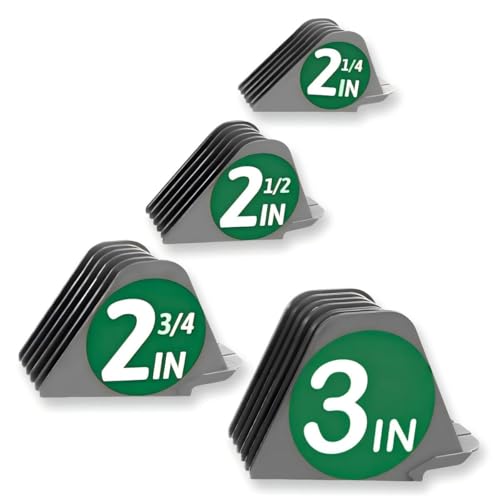
Please check your HAIR CLIPPER'S SIZE/MODEL before purchased.Not fit for PEANUT, POWER PRO TRIMMER, PRO, KM2 and SMALL/MINI HAIR CLIPPER. QPOIBSD Clipper Limit Comb Compatible With WAHL 6102, 2150, 2151, 2171, 2170, 2160, 2110, 21062, 6130, 8591, 8148, 1919, 8504, 6200, 6211, 2240, 2241, 2111. And it also can be applied to clipper with 46*38mm blade

Please check your HAIR CLIPPER'S SIZE/MODEL before purchased.Not fit for PEANUT, POWER PRO TRIMMER, PRO, KM2 and SMALL/MINI HAIR CLIPPER. QPOIBSD Clipper Limit Comb Compatible With WAHL 6102, 2150, 2151, 2171, 2170, 2160, 2110, 21062, 6130, 8591, 8148, 1919, 8504, 6200, 6211, 2240, 2241, 2111. And it also can be applied to clipper with 46*38mm blade

14 Piece Kit: Includes hair clipper guards from 1/2 (1/16") all the way up to 8 (1")
When to Use Trimmers for Edge Work and Finishing
Trimmers excel where clippers can’t—delivering the precision lines and sharp finishes that define a polished haircut. You’ll use trimmers exclusively for edge finishing, where control matters most.
Start with trimmer techniques that create crispy lineups along your hairline. Position your T-blade trimmer to follow your natural hairline curve, punching rather than sliding for clean edges. You’ll frame corners as markers, adjusting with a comb for balance. Regularly combing hair forward during the trimming process ensures consistent technique and prevents misplaced blade positioning. For specialized grooming needs in sensitive areas, consider using ceramic blade trimmers designed for comfort and precision.
For sideburns and ears, fold ears forward and chip upward in C formations for softer changes. Use your trimmer’s corner edge for finer details around mustaches and beards. While electric shavers like the F5-5800 model offer powerful motors for various facial hair types, trimmers provide the specialized control needed for precise edge work that shavers cannot achieve.
Finally, apply pre-shave oil and finish with a straight razor against taut skin. This edge finishing approach transforms a basic cut into a professional result.

Safe and Efficient Trimming: PRITECH razors for men uses ceramic blades with built-in protection. On the surface where the blade contacts the skin, we have implemented a chamfered design, ensuring that it never cuts, pulls, or irritates the skin, and guarantees efficient hair trimming. This body trimmer for men equipped with 3 adjustable comb attachments and 5 lengths (1.5mm, 3mm, 6mm, 9mm, 12mm), it meets your diverse trimming requirements

Body, Pubic, Groin&Bikini- OLOV trimmers were designed for below-the-waist grooming but work great on your not so private parts too

𝗕𝘂𝗶𝗹𝘁 𝗳𝗼𝗿 𝗠𝗲𝗻’𝘀 𝗕𝗼𝗱𝘆 & 𝗚𝗿𝗼𝗶𝗻 𝗚𝗿𝗼𝗼𝗺𝗶𝗻𝗴 - Designed as a body trimmer for men, this 2-in-1 grooming kit helps trim body hair, groin hair, pubic hair, chest, underarms, beard, nose and ear hair with one compact tool. A practical choice for everyday manscaping and full-body grooming
Combining Both Tools for Professional Results
To achieve a seamlessly blended fade that distinguishes professional work from amateur cuts, you’ll integrate clipper and trimmer techniques in a strategic sequence. Start with clippers using progressively smaller guards—beginning at #3 on the sides and moving to #4 for top blending. This establishes your base changes efficiently.
Next, deploy your trimmer for precision edge work around sideburns, nape, and hairline where clipper guards can’t reach effectively. Your trimmer’s narrower blade delivers the clean lineup your clippers can’t match in tight areas. Selecting the appropriate guide comb size for the desired hair length and attaching it securely will prevent uneven cutting when transitioning between tools. For optimal results with coarse or thick whiskers, consider trimmers with powerful motors delivering high cuts per minute to handle dense beard growth effectively.
Throughout this combined approach, maintain consistent tool maintenance by checking combs for hair buildup and ensuring secure attachments, similar to how you would thoroughly dry your trimmer after each use to prevent corrosion and extend its lifespan. Your blending techniques improve dramatically when both tools perform effectively, resulting in fade lines that appear intentional and refined.

Heavy Duty Motor – Our ultra-power heavy duty hair trimming system easily cuts the thickest hair with 35 percent more power than standard Wahl electromagnetic motor clippers, This results in a very strong audible hum, but is completely normal to its operation. Don’t settle for a weak clipper.

💇♂️Professional Hair Clipper and Trimmer Set-- The large hair clipper can be used to shave both hair and beard, while the small trimmer is equipped with a T-shaped blade for zero-gap trimming of sideburns and edges around the ears. You can easily get the haircut you want at home, just like in a hair barbershop

PRO TESTED, CREATED FOR ALL - Our Novah barber kit has been tested in some of the best barbershops around the world to do what they do best. Our barber clippers professional sets are being used worldwide to give zero gap cuts to the men who walk the walk. We have brought our most trusted professional cordless hair clippers to now be available to all
Match Your Tools to Your Grooming Routine
Selecting the right tool depends entirely on your grooming priorities and hair characteristics. If you’re maintaining longer hair length or performing frequent bulk reductions, clippers are your best choice. Their high-torque motors handle thick, coarse hair efficiently, and adjustable guards provide precise length control across multiple sessions.
Conversely, if your grooming frequency centers on edge maintenance and detail work, trimmers excel. They’re engineered for close-to-skin cuts on hairlines, beards, and sideburns without bulk removal. Trimmers focus on detailing and refining hairstyles to elevate the overall appearance. Like maintaining sharp blades through consistent honing techniques, keeping trimmer blades sharp ensures clean, precise cuts on facial hair. Professional barbers consistently recommend trimmers with zero-gap blades for achieving the precision needed in detail work and edge maintenance.
Match tool power to your hair density: high-torque clippers for coarse textures, finer trimmers for short hair. Your routine’s demands—whether structural foundation work or finishing touches—should dictate your primary tool. Many professionals maintain both for thorough results.
Buying Guide: Budget, Cordless, and Quality
When you’re ready to invest in grooming tools, you’ll find options across every price point and feature set. Budget considerations matter: entry-level clippers run $20–$50 with standard guards, while trimmers cost $15–$40 for precision work. Mid-range models ($50–$100) deliver superior motors for thick hair.
Cordless advantages become clear with extended runtime—clippers offer 90–120 minutes per charge, trimmers provide 60–100 minutes. Lithium-ion batteries recharge in 1–2 hours, and lightweight models weigh under 0.5 lbs for maneuverability. Taper levers on cordless clippers allow you to make fine adjustments between guard lengths without losing battery power during styling.
Quality distinguishes durability. Stainless steel blades resist rust and last 1–2 years. Adjustable levers enable taper control, while snap-on guards guarantee consistent lengths. For at-home grooming, consider using professional shears rather than standard equipment for precision trimming. Premium kits include T-blades for fading versatility, and versatile models like the Philips Norelco OneBlade 360 offer pivoting heads for precise control across different grooming areas. Brands like Wahl and Andis average five-year lifespans with proper maintenance.

Color Coded Guide Combs – Finding and remembering everyone’s favorite hair length is easier than ever. Corresponding the correct comb to the right cutting length is simple with our easy to see attachment guards
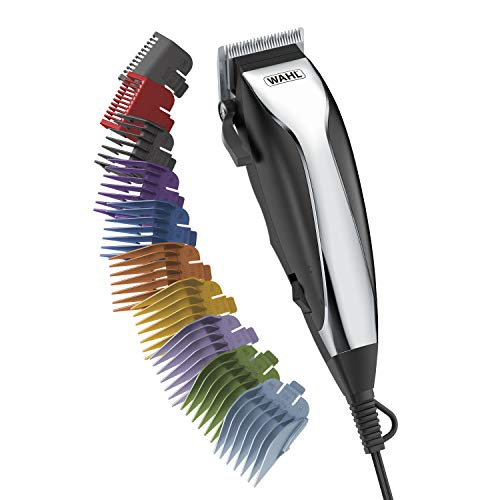
Multi-Cut Hair Clipper - Heavy duty motor for exceptional power and no-snag cutting; features an adjustable taper lever for easy blending and fading. This results in a very strong audible hum, but is completely normal to its operation. Don’t settle for a weak clipper.

Heavy Duty Motor - Our PowerDrive Plus heavy-duty motor delivers exceptional power for no-snag cutting and runs 15% cooler vs. our standard PowerDrive motor. This powerful electric shaver cuts through the thickest of hair with no snags or pulls