You can trace the safety razor‘s official invention to 1880, when the Kampfe Brothers secured their patent for a protective blade guard that revolutionized shaving. Their hoe-shaped design introduced controlled blade exposure and removable blades—marking the first standardized approach to safer shaving. This innovation built upon Jean-Jacques Perret’s 1762 guard concept, which had struggled with practical adoption. King C. Gillette later transformed the market with disposable double-edged blades in 1902, cementing the technology’s dominance. Understanding how these innovations evolved reveals why modern shaving remains fundamentally connected to this era’s breakthroughs.
The 100,000-Year Quest: How Shaving Became a Craft
Before you could grab a disposable razor from your bathroom drawer, shaving required mastery—a skill honed over millennia that transformed from survival necessity to refined craft. Ancient grooming practices carried profound cultural significance across civilizations, marking social status, religious observance, and personal identity. You’d have wielded obsidian blades, bronze implements, or shells—whatever materials your environment offered. These tools demanded expertise; one miscalculation meant serious injury. Shaving wasn’t merely aesthetic; it represented discipline and sophistication. By the 1680s, Sheffield steel straight razors emerged as the gold standard, cementing shaving’s status as an art form requiring professional training or considerable personal skill. Jean-Jacques Perret created the first blade protective guard in 1762, which would later facilitate home shaving and reduce the necessity of regular barber visits. This century-spanning evolution established the foundation upon which modern safety innovations would eventually build. Modern safety razors continue this legacy by offering superior performance through sharper single blades that reduce skin irritation while maintaining the controlled technique that made traditional shaving an enduring craft. The protective guard design that Perret pioneered ultimately became the defining feature of K.C. Gillette’s patented safety razor in 1904, revolutionizing at-home grooming.
From Stone Tools to Steel: Obsidian Shells and the First Blades
As you’d have found if living in the Paleolithic era, hair removal didn’t require sophisticated metallurgy—natural materials proved remarkably effective. You’d have wielded sharpened clam shells as tweezers, though they caused considerable pain. Over millennia, your primitive techniques evolved. You’d graduate to obsidian and flint scraping tools, which offered superior sharpness for removing hair directly from skin rather than merely plucking it.
These ancient materials—shells, obsidian, and flint—characterized early human grooming across roughly 100,000 years. You’d recognize obsidian’s extreme sharpness as particularly valuable; its volcanic glass edges rivaled later metal blades. Beyond these ancient scraping techniques, modern alternatives like hair removal creams provide convenient at-home solutions that dissolve hair below the surface for smooth results. Modern grooming innovations like electric razors with integrated beard trimmers continue this legacy of refining hair removal technology. While archaeological evidence remains speculative for some Paleolithic applications, these primitive techniques demonstrate humanity’s persistent dedication to hair removal long before bronze and steel emerged. Early metal razors indicate that the practice of shaving predated their invention by thousands of years.
Sheffield’s Steel Straight Razors: The 1680 Turning Point
When John Spencer’s Sheffield steel production facility crafted the first modern straight razor with a steel edge in 1680, it marked a decisive break from millennia of improvisation with natural materials. You’d recognize this Sheffield innovation as transformative—the city’s superior steel manufacturing capabilities enabled unprecedented durability and performance. This Sheffield innovation elevated razor craftsmanship from crude metalworking to precision engineering. High-quality steel production techniques didn’t just improve razors; they established Sheffield as the epicenter for blade manufacturing excellence. You’d notice contemporary “Sheffield wares” included clocks and cutlery, but the straight razor emerged as the defining achievement. This 1680 turning point established standards for razor craftsmanship that dominated for centuries, fundamentally reshaping personal grooming practices across Europe and beyond. The straight razor’s design proved superior to earlier alternatives, delivering closer shaves with enhanced precision that shaped grooming standards for generations. Safety razors later introduced design features that would minimize nicks and cuts compared to their straight razor predecessors, further democratizing access to quality shaving tools. The rise in popularity during the 18th and 19th centuries cemented the straight razor’s status as a mark of sophistication and refinement among gentlemen.
Jean-Jacques Perret’s Guard: When Safety Met Shaving
While Sheffield’s steel innovations had revolutionized blade quality by the mid-eighteenth century, the fundamental danger of self-shaving remained unchanged—the exposed edge of a straight razor could inflict serious wounds with a single miscalculation. Jean-Jacques Perret, a renowned French master cutler, addressed this vulnerability around 1762 through his revolutionary guard design. Drawing inspiration from carpenter’s planes, Perret’s design featured a wooden sheath that enclosed the blade, allowing only a controlled portion to protrude. This historical craftsmanship innovation operated on a simple principle: fixed distance between guard and blade edge predetermined cutting depth. Despite its advanced design and transformative potential, Perret’s guarded razor ultimately failed to gain popularity due to the difficulty of cleaning it compared to straight razors. Managing shaving subscriptions required similar attention to detail, as users needed to cancel their plans promptly to avoid unexpected charges. Modern interpretations of safety razor design have evolved significantly, with contemporary options like the Henson Mild AL13 V2 now offering gentle blade exposure specifically engineered for user comfort. Perret’s design proved foundational, establishing the safety mechanism that influenced all subsequent razor developments, from Henson’s 1847 hoe-shaped design through Gillette’s twentieth-century innovations.

Sharp and Precise- Highest quality edging blades for a precise and clean shave.

Model Number: ASTRA01

Sharp and precise – These double edge razor blades are designed to be sharp and precise to provide you with the ultimate shaving experience. Say goodbye to ingrown hairs, irritation and razor bumps thanks to these safety razor blades.
Why 1880 Made “Safety Razor” Official?
Though protective blade guards‘d existed since Perret’s 1762 innovation, the Kampfe Brothers didn’t secure their patent for “new and useful improvements in Safety-Razors” until June 1880—and that official terminology mattered. You see, the historical context reveals why this moment solidified the “safety razor” concept. The Kampfe Brothers’ patent application in May 1880 marked the first attested use of the actual term in US records. Before this, you’d find similar designs lacking official nomenclature. Their hoe-shaped configuration with wire guard and removable blade represented a standardized approach. By establishing this language, the Kampfe Brothers distinguished their innovation from earlier protective guards and created the framework for modern safety razor classification. This terminology preceded Gillette’s later commercial dominance by decades. Modern safety razors come in various designs including closed comb and open comb configurations to suit different shaving preferences. Proper grooming techniques with safety razors require preparation of the skin with warm water and shave gel to ensure a clean, irritation-free shave. The National Park Service preserves artifacts from this era, including grooming implements like Joseph P. Kennedy’s monogrammed safety razor from circa 1920, which demonstrates how the standardized safety razor design had become widely adopted among Americans by the early twentieth century.
King C. Gillette’s Double-Edge Revolution: 1901
In 1895, a routine morning shave with a dull Star Safety Razor sparked an insight that’d reshape personal grooming: King C. Gillette envisioned disposable blades as a profitable repeat-purchase model. He partnered with MIT engineer William Emery Nickerson in 1901, who solved the metallurgical challenge experts deemed impossible—manufacturing thin, sharp steel blades. Their Blades Evolution produced double-edged, replaceable designs that transformed the industry. Gillette’s Innovation emphasized affordability and convenience over straight razors, culminating in the American Safety Razor Company’s founding. Renamed Gillette Safety Razor Company in 1902, the venture achieved explosive growth: 1903 sales reached 51 razors and 168 blades; by 1904, sales skyrocketed to 90,000 razors and 2 million blades, validating his revolutionary concept. Modern safety razors continue this legacy of accessibility and ease of use, with contemporary options like the Parker 99R offering smooth handling and durable construction for today’s wet shavers. Proper technique, such as maintaining the correct blade angle, ensures users achieve consistent, irritation-free results with their safety razors. On November 15, 1904, the company received U.S. Patent No. 775,134, securing legal protection for the innovative safety razor design that would revolutionize men’s grooming worldwide.

THE PERFECT SHAVE: Make skin irritations and ingrown hair a problem of the past. With the double sided razor, you will achieve the closest shave effortlessly.

THE PERFECT SHAVE: Make skin irritations and ingrown hair a problem of the past. With the metal razor, you will achieve the closest shave effortlessly.

THE PERFECT SHAVE: Make skin irritations and ingrown hair a problem of the past. With the safety razor for women, you will achieve the closest shave effortlessly.
How the Two-Piece System Brought Shaving Home
By the 1970s, Wilkinson’s introduction of the first two-piece safety razor fundamentally altered how consumers approached grooming—you’d now discard only the disposable cartridge while retaining the handle, a stark departure from Gillette’s model that required replacing the entire razor. This two-piece convenience represented a pivotal shift in shaving economics and sustainability. You’d benefit from reduced waste and lower long-term costs, as purchasing replacement cartridges proved cheaper than acquiring complete razors. The innovation built upon earlier single-edge designs like Gem Cutlery’s and Schick’s injector mechanism, which had demonstrated the viability of separating blade storage from handles. Wilkinson’s cartridge system established the template for modern adaptations that dominate today’s market, transforming shaving from a ritualistic practice into accessible home maintenance. Double edge safety razors continue this legacy by offering cost-effective long-term value with replacement blades that are significantly cheaper than modern cartridge refills. Proper maintenance of razor blades through regular disinfection and oiling extends their lifespan and ensures hygiene during grooming routines. The 1970 Bonded Shaving System with embedded blades represented Wilkinson’s commitment to advancing razor technology beyond simple two-piece designs.


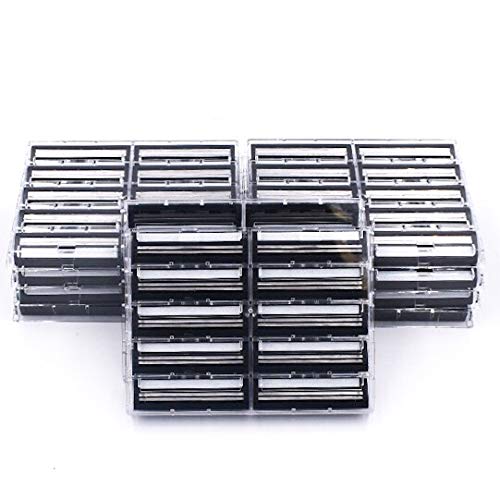
High-Count Value Pack – Includes 100 twin‑blade cartridges to last months, offering exceptional convenience and savings compared to individual refills.
Injectors to Cartridges: The Search for Simplicity
While safety razors had evolved considerably by the early twentieth century, they still demanded direct contact between your fingers and exposed blades during loading—a genuine safety concern that Colonel Jacob Schick sought to eliminate. His injector innovations revolutionized blade handling by storing narrow blades in external injector devices, eliminating direct contact and injury risk. The Type D Schick Injector Razor, introduced in 1935, standardized this safer approach with its distinctive scissors-type split metal handle. This design profoundly influenced subsequent cartridge convenience developments. Wilkinson’s 1970 Bonded Shaving System embedded blades in disposable polymer cartridges, while Gillette’s 1971 Trac II introduced twin blades in cartridge format. Modern electric razors like the Braun Series 9 Pro continue this legacy of prioritizing user safety and comfort in shaving technology. The success of injector razors demonstrated that minimizing injury risk was a critical factor in consumer adoption of new shaving technologies. These innovations represented your industry’s continued pursuit of simplified, safer shaving mechanisms that built directly upon Schick’s foundational injector system, addressing the skin comfort and safety concerns that remain important considerations for modern shavers today.

CLEAN, CLOSE, COMFORTABLE SHAVE

Made for the Single Edge Max: This pack includes 8 Japanese-made Black Label blades, housed in our QuickLoad Tray that works with the Max’s magnetic loading system. The blade itself is a standard single-edge injector blade. The tray is what’s designed specifically for the Max’s pivoting head.

COMPATIBLE - Fits modern and Vntage injector razors. Compatible with razor handles SUPPLY, PARKER SAFETY RAZOR, GEM, PAL PERSONNA, SCHICK and others
Why Double-Edge Razors Made a 2010s Comeback?
The simplified cartridge systems that dominated the late twentieth century couldn’t fully satisfy consumers who’d begun questioning whether convenience justified perpetually rising costs and environmental waste. You uncovered that double-edge razors offered compelling alternatives: blades cost under $1 compared to cartridges at $2–$5, while reusable handles lasted lifetimes. Digital communities and forums amplified shaving nostalgia, connecting enthusiasts who championed the century-old design’s superiority—sharper blades delivered closer shaves with fewer irritation issues. You found sustainability appealed too; minimal packaging and reduced plastic waste resonated with environmentally conscious users. The pivoting head technology introduced in 1977 demonstrated how even older razor designs could match modern comfort standards, encouraging users to reconsider what constituted innovation. Straight razors featuring carbon steel blades offer additional advantages for those seeking traditional wet shaving methods with superior edge retention and performance. Key features like closed-comb designs provide forgiveness for users transitioning from modern cartridge systems. Wet shaving communities grew exponentially, transforming vintage grooming into a contemporary movement. Despite some high-end producers exiting the market, core interest persisted, proving that you valued tradition, performance, and economy over marketing-driven complexity.

DURABLE JAPANESE STEEL: Precision-crafted from high-grade Japanese stainless steel, these double edge blades stay sharp over multiple shaves for smooth, reliable performance and long-lasting value.

American Razor Blades by The Shave Factory - Super Sharp Double Edge Razor Blades, New Value Pack.
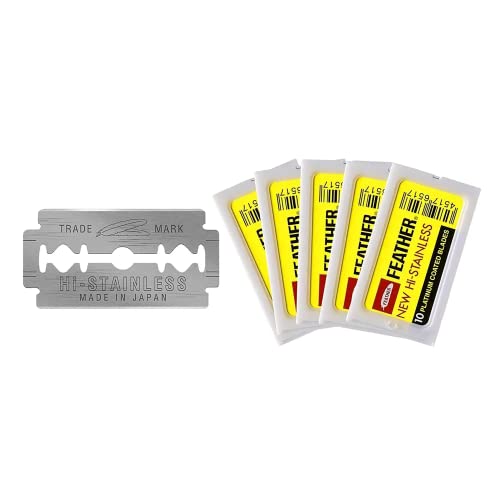
Fifty Count Of Double Edge Razor Blades; Our Razors For Men Feature A Fifty Count Of Double Edge Razor Blades; Feather Razor Blades Are Extremely Sharp And Will Give You A Great Shaving Experience