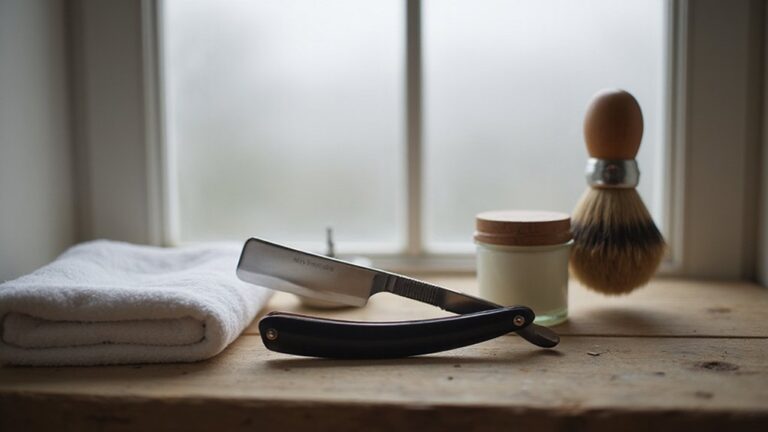
To hone your straight razor, you’ll first flatten your stones using a DMT plate, then set the bevel with moderate pressure and circular strokes until a burr forms on both sides. Progress through increasingly fine grits—1k, 4k, and 8k—using edge-trailing strokes with light pressure, alternating sides with about 20 strokes per grit. Create a micro-convex apex at 4k grit or finer to maintain consistent pressure. Finally, verify sharpness with the arm hair and hanging hair tests. The stropping techniques you’ll master next are what truly preserve your blade’s performance.
Prepare Your Blade and Stones for Honing
Before you begin honing, you’ll need to ascertain your stones are perfectly flat and your blade is ready for the process. Start with stone lapping using either a DMT plate or 400-grit sandpaper taped to a granite surface. Wet your stone thoroughly, apply pencil hash marks across the surface, and lap with consistent pressure until the marks disappear completely. This removes swarf buildup and exposes fresh abrasive material.
For blade inspection, use a 12x magnifying loupe to examine your straight razor’s edge for damage or dullness. Gather your essential tools: synthetic wet stone, DMT diamond plate, mechanical pencil, sandpaper, drying cloth, and tape for spine protection. Ascertain all materials are clean and accessible before beginning your honing session. Unlike cartridge razors with multiple blades and lubricating strips, straight razors require more meticulous preparation and care. To maintain your razor’s longevity and performance, practice regular cleaning and maintenance alongside proper honing technique. The art form of straight razor sharpening has diminished significantly over the past six decades, making it increasingly important to learn proper technique from experienced sources.

Dual Grit Design (3000/8000) - Achieve razor-sharp precision with this two-sided whetstone: Use the 3000 grit for refining and the 8000 grit for ultra-fine polishing to restore a mirror finish on your blades

Professional Whetstone: 2 whetstones have difference grit which are 400/1000 and 3000/8000. The grit is accurate. 4 sides grit are satisfy with any knife blade needs. 400/1000 grit is typically used to repair knives with chipped edges and sharpen dull knives. 3000/8000 grit used to refine the edge and provide extra fine finish/polish on your blades.

The sharpening stone is suitable for any daily sharpening, such as repairing the knives with big cutting edges, and polishing the knives, the sharpening stone will help you to make the knives more smooth
Set the Bevel on Your First Hone
Now that your stones are flat and your blade is inspected, you’re ready to establish the proper bevel angle on your straight razor’s edge. Begin with moderate pressure application on your coarse stone, using tiny circular strokes to cut steel evenly across the bevel. Work one side with 30-40 circles, then flip and repeat on the opposite side. This creates burr formation—your confirmation that you’re establishing proper contact. Monitor this burr carefully as it raises and hones away alternately on each side. Continue cycling until the burr develops consistently on both sides, indicating your bevel’s two planes meet at the apex. Like the adjustable lever on clippers, proper bevel angle requires precise positioning to achieve seamless transitions and professional results. Checking your blade’s growth direction and density helps ensure you’re working with the grain for optimal results. This process sets your foundation for subsequent honing stages. Bevel setting should ideally occur only once, establishing a permanent foundation for all future maintenance honing on your razor.
Master Your Edge-Trailing Stroke
Once you’ve established your bevel and created consistent burr formation, you’ll shift to edge-trailing strokes—the polishing phase that refines your apex without heavy abrasion. Here, your spine leads while the edge trails behind, allowing you to polish away micro-burrs and create a clean, even edge.
Execute 20 edge-trailing strokes on your 1k stone using an X-stroke pattern. Maintain consistent bevel angle with light pressure to prevent blade flexing—this preserves edge control and guarantees stroke precision. Progress to your 4k-8k hones with 20 strokes each, alternating sides equally in groups of 10-20. Remember that spine leading strokes should only be used as a very light final touch, not as your primary honing method. Proper maintenance of your straight razor through regular honing extends its longevity compared to disposable options and keeps it in optimal shaving readiness****.
The result? A foil edge with enhanced purity, visible as a brighter white line. This finishing work minimizes wire edge risks and prepares your razor for shaving readiness. Unlike modern safety razors with protective guards, straight razors demand this meticulous honing process to maintain their superior precision and control.
Step Up Through Grit Levels
After establishing your foil edge, you’ll progress through increasingly fine stones to remove scratches from previous grits and refine the bevel’s surface. Your grit selection should roughly double between stones—moving from 1000 to 2000 to 4000, for example—though your available equipment may dictate variations.
Apply consistent progression techniques by reducing lap counts as grits increase. Start with 50+ laps at coarser grits, then decrease to 20-30 laps at 4000-8000 grits. This shift reflects the change from metal removal to polishing. Regular maintenance with clipper-specific oil and proper cleaning techniques will help preserve your honing stones and tools over time. For optimal tool longevity, store your stones in a dry location away from heat and humidity.
Assess your bevel every 20-30 laps using microscopic inspection or hair-cutting tests. Most razors achieve satisfactory shaving performance by 8000 grit, though you can continue to 10000-16000 for superior results if desired. Remember that higher grit does not automatically result in sharper edges, so focus on proper technique and bevel quality rather than simply pursuing finer stones.

【Complete Knife Sharpening Stone Kit】You don't need to be a Pro to sharpen your blades, all you need is the right tools & technique. All the sharpening tools you need are here, one affordable set for you: 400/1000 & 3000/8000 grit whetstone; Coarse flattening stone; Non-Slip Bamboo base; Knife sharpening angle guide; Leather strop, a simple instruction manual about how to use and what does every component do.

🔪【Professional Whetstone Set】We provide all the necessary knife sharpening tools you need, comes with high quality grit 180/320 400/1000 3000/8000 Whetstone, Flattening Stone, Bamboo base, Leather Block, Angle guide, Polishing compound, Leather strop, Silicone Holder, Honing Guide and Cut Resistant Gloves.

* This ergonomic designed Stainless Steel made sliding style straight CUT THROAT razor is very for you.
Create a Micro-Convex Apex
Creating a micro-convex apex is crucial to removing the foil burr that forms during honing and preparing your razor for stropping. You’ll apply a slight curve—approximately one micron or less—to your blade’s apex using apex polishing techniques on your fine hone.
During fine honing, you’ll polish away the apex damage created by coarse honing, producing a keen triangular edge. Work at 4k grit or finer to achieve this finish. The micro convexity benefits include maintaining consistent pressure along your bevel during stropping and reducing edge width to the 50nm level. High-quality hones like Naniwa or Shapton are recommended to ensure you achieve the precise micro-convex geometry needed for optimal results.
This micro-convex geometry guarantees uniform abrasion during subsequent stropping while minimizing burr formation. Proper apex creation sets the foundation for achieving peak blade performance through stropping.
Strop and Test Your Sharpness
Stropping realigns and polishes your razor’s edge, transforming the micro-convex apex you’ve created into a shave-ready blade. Begin with proper strop preparation by securing your strop tautly and ensuring it’s clean and dust-free. Use the canvas side first to warm the blade before moving to leather.
For stropping technique, lay your razor flat with spine and edge in full contact. Draw the blade toward you, leading with the spine and applying minimal pressure. Perform 30-50 slow, gentle repetitions, rolling the razor over its spine at the strop’s end without lifting. The spine of the blade must remain in constant contact with the strop throughout each stroke to ensure proper edge alignment. Unlike electric razors designed for sensitive skin, straight razors require this meticulous stropping maintenance to achieve optimal sharpness and performance. While electric shavers with rotary blade systems offer convenience for quick grooming, straight razors demand dedicated honing and stropping to maintain their superior cutting edge.
Test your results by checking for smooth gliding and minimal nicks. Your blade should perform consistently with short, steady strokes, confirming proper edge alignment.

Size:45*5cm/18*2". Material: Cow Leather.

At 19.76 x 2.04 inches, this leather strop is crafted from high-grade cowhide, offering exceptional durability for consistent use.

✅ Premium Leather Conditioning Paste (30ml) Formulated to soften, preserve, and protect leather strops—keeps your sharpening tools in excellent condition for long-term use.
Verify Your Edge Is Ready
How do you know your blade’s truly ready for shaving? You’ll verify through systematic edge inspection using multiple sharpening techniques.
Start with the arm hair test—glide your razor across arm hair without pressure. A sharp edge slices effortlessly at skin level with no tugging. Next, perform the hanging hair test by holding a single plucked hair perpendicular to your edge. It should split cleanly without bending.
Use magnification inspection with a 10x loupe to examine scratch patterns along both bevel sides. You’re looking for even scratches reaching the apex without light reflection indicating incomplete honing. Regular stropping before each shave maintains this sharpness and prevents micro-damage to your blade. For those seeking alternatives to traditional straight razors, electric shavers for women offer convenient options with precision engineering and skin-protective designs.
Finally, conduct the thumbnail test on a wet thumb. Your edge should bite smoothly with consistent resistance from heel to toe, confirming your bevel meets properly at the apex.
Keep Your Razor Stropped Daily
Daily stropping realigns your blade’s edge and maintains its sharpness without requiring honing, which extends your razor’s lifespan significantly. You’ll strop before shaving, ideally after showering, using proper strop techniques to prevent performance decrease over time.
Secure your strop taut and position yourself to the side. Lay your razor flat with the spine down first, then let the edge contact the strop. Push the blade away leading with the edge using minimal pressure, then pull toward your body leading with the spine. Flip over the spine only—never the edge.
Perform 50 laps on the leather side for best results. This daily practice avoids irritation and guarantees consistent shave quality. Your steel’s self-healing memory activates during stropping, maintaining razor performance between honing sessions. For optimal results, maintain a consistent 30-degree angle when stropping to ensure proper edge alignment. Like canceling unwanted subscriptions, managing your grooming routine requires taking proper action to prevent unnecessary complications. With practice and patience, you’ll develop the proper stropping technique that prevents blade damage and ensures your razor remains sharp for years to come.

Double-Sided Leather Strop: Features a smooth side and a suede side to meet different stropping needs — perfect for refining and polishing your blade edge

Razor-Sharp Edges: Keep your blades extra sharp with this leather strop for knife sharpening. Use this leather honing strop for knives, axes, gouges, chisels, plane blades, and chef's knives

Premium Genuine Cowhide - Built to Last: Pre-assembled with compounds included. Made from thick, vegetable-tanned genuine cowhide that resists tearing and lasts for thousands of uses. No messy oils or sprays – just apply the included compound and start stropping.