You’ll achieve the perfect buzz cut by matching clipper guard numbers to your desired length. Guards #0–#2 create skin-level fades at 0–6mm, ideal for ultra-short cuts. Mid-range #3–#4 guards deliver classic 9–13mm lengths perfect for everyday styles. For thicker hair, #5–#6 guards provide 5/8–3/4 inch coverage with styling flexibility. Your hair type, face shape, and maintenance frequency should guide your selection, though understanding how guard shifts create seamless fades requires exploring technique specifics.
What Each Guard Number Actually Means
Understanding clipper guard numbers is essential because they directly control your cut’s length—each number represents a specific measurement in eighths of an inch, ranging from 0 to 8. A #0 guard delivers skin-level fades at 0 inches, while #1 through #3 provide increasingly longer coverage from 1/8 to 3/8 inch. Numbers #4 through #8 extend from 1/2 to 1 inch, offering substantial length for textured styles.
Guard comparisons reveal that higher numbers expose less scalp, making them ideal for maintaining hair volume. Half-guards like #0.5 and #1.5 enable precise shifts between lengths. Understanding guard adjustments through lever mechanics guarantees you achieve your desired cut accurately. Since shorter guard numbers expose more scalp, maintaining your shaved or closely cropped areas requires daily moisturization to keep the exposed skin healthy and comfortable. Hair texture influences the appearance of each guard number, with fine hair potentially appearing thinner with shorter numbers while thick hair handles aggressive cuts due to greater density.
Knowing these distinctions helps you communicate clearly with barbers and make informed decisions about your haircut preferences.
Choosing the Right Guard Length for Your Hair Type
Since your hair’s texture and density directly affect how a guard number translates to actual coverage, selecting the right length requires matching the guard to your specific hair characteristics. Thick hair demands guards #3–#5 to prevent scalp exposure and manage bulk effectively. Fine hair benefits from #4–#6, which preserves visible length and prevents flatness. Your hair texture matters equally—straight hair suits uniform #3–#5 cuts, while curly hair needs #5–#8 to maintain pattern integrity. Consider your face shape too: round faces elongate with #4–#6 on top and shorter sides, while square faces soften via #5–#7 uniform length on fine hair. Remember that higher guard numbers correspond to longer hair lengths, allowing you to customize your cut precisely. Professional barbers understand that clippers establish the foundation of a haircut before using trimmers for detailed finishing work. Brand inconsistencies mean you should always check the labeled lengths in inches or millimeters marked directly on each guard rather than relying solely on the number designation. Understanding these pairings guarantees your buzz cut aligns with current trends while optimizing your fading techniques and overall styling preferences.
Guards #0–#2: Skin Fades and Ultra-Short Buzz Cuts
The shortest guard lengths—#0, #1, and #2—form the foundation of skin fades and ultra-short buzz cuts, each offering distinct scalp visibility and styling versatility. You’ll achieve your closest cut without a razor using the #0 guard, which leaves just 1.5mm of hair and creates a pronounced 5 o’clock shadow effect. The #1 guard delivers 3mm of length, revealing scalp while maintaining visual interest for ultra short styles. With the #2 guard, you get 6mm of fuller-looking hair, reducing scalp exposure.
For skin fade techniques, you’ll start with #0 or #1 at the base and blend upward using progressively longer guards. Before beginning, assess your scalp for any bumps or irregularities to avoid irritation during the clipping process. This gradual shift creates high-impact results. Professional barbers often prefer rotary motor types for their power and speed when executing precision fades. Pairing lower guards with higher ones develops seamless fades that define modern barbering aesthetics while keeping maintenance minimal. Remember that clipper guard sizes vary across different brands, so focus on the actual length in millimeters rather than just the guard numbers when selecting your tools. Using an upward rocking motion during application helps ensure even coverage and a professional finish.

【Compatibility and Versatility】Compatible with wahl clipper guards set, our premium guards compatible with all full-size Wahl clippers except Competition Series and 5-in-1 Magic blades. Each set includes 2 pieces, ensuring you have the right tools for precise trimming. Perfect for professionals and home users alike, these guards provide reliable performance.

【Guide Comb Attachment】This clipper guards set is designed for Wahl beard trimmer attachment.Clipper guards guide comb 1/2 Attachment is black in color and provides a 1/16" (1.5mm) length,Each set includes 2 pieces.

[Guard Size and Compatibility] Clipper guards guide comb #1/2 Attachment (#3137-101) is grey in color and provides a 1/16" (1.5mm) length. Fits all Wahl full size clippers blades except for Competition Series and 5-in-1 Magic blades.
Guards #3–#4: Classic Crew Cuts and Textured Looks
Moving into mid-range guard lengths, #3 and #4 establish the practical foundation for versatile, everyday haircuts. The #3 guard leaves 9-10mm of hair, marking where buzz cut territory truly begins with enough texture for movement. The #4 guard delivers the classic 12-13mm length—the most popular buzz cut option—entering crew cut territory seamlessly.
You’ll achieve crew cut variations by pairing #4 on the sides with longer lengths on top, like a #8 guard. For textured styles, layer #3 on lower sides with #4 on upper sides, adding #5 for dimensional depth. This combination reveals texture while maintaining clean edges. The butch cut represents the optimal choice for first-time buzz cut wearers seeking balanced versatility across different face shapes and lifestyles.
Both guards suit low-maintenance styling and require cutting every 3-4 weeks. These lengths work particularly well for individuals with straight and coarse hair types, which hold shape and definition effectively. Professional-grade clippers like the Wahl 5 Star Magic Clip deliver precision cuts that maintain these guard lengths with consistency and zero-overlap blade technology. They blend effortlessly for modern tapered looks without excessive product or styling effort.
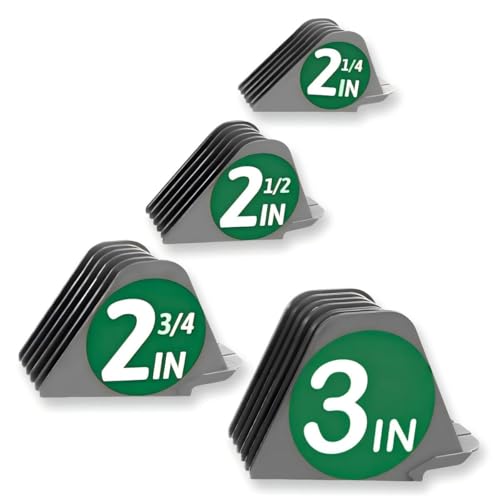
Please check your HAIR CLIPPER'S SIZE/MODEL before purchased.Not fit for PEANUT, POWER PRO TRIMMER, PRO, KM2 and SMALL/MINI HAIR CLIPPER. QPOIBSD Clipper Limit Comb Compatible With WAHL 6102, 2150, 2151, 2171, 2170, 2160, 2110, 21062, 6130, 8591, 8148, 1919, 8504, 6200, 6211, 2240, 2241, 2111. And it also can be applied to clipper with 46*38mm blade

14 Piece Kit: Includes hair clipper guards from 1/2 (1/16") all the way up to 8 (1")

Compatible with Most Wahl Clippers: These replacement clipper guards are designed to fit most full-size Wahl clipper blades (1.8" x 1.5" / 45 mm x 38 mm). Ideal for replacing worn or lost guards and maintaining consistent haircut performance.
Guards #5–#6: Textured Buzz Cuts With Styling Options
As you move into the #5 and #6 guard range, you’re entering territory where styling options expand considerably without sacrificing the low-maintenance appeal of a buzz cut. The #5 guard delivers approximately 5/8 inch length, while the #6 yields 3/4 inch—both ideal for thick or coarse hair that benefits from maintained volume.
Employ texture techniques like point-cutting with scissors and reverse thinning shears to create dimension and smooth gradients. Layer subtly across your scalp for natural movement and depth. These textured buzz cuts work exceptionally well for various face shapes, making them versatile options for different clients. Unlike shorter buzz cuts that require maintenance trims every 3-4 weeks, these longer guards allow for extended wear while maintaining visual appeal. To keep your clippers performing optimally during styling sessions, remember to maintain proper clipper lubrication between uses.
Styling becomes more flexible here. Apply style products like fiber or matte powder to shape and hold your cut. You can spike the top for a contemporary look, style forward and messy, or experiment with blunt hairlines for sharp definition. Pair these lengths with mid skin fades or tapers on the sides for seamless blending.

Please check your HAIR CLIPPER'S SIZE/MODEL before purchased.Not fit for PEANUT, POWER PRO TRIMMER, PRO, KM2 and SMALL/MINI HAIR CLIPPER. QPOIBSD Clipper Limit Comb Compatible With WAHL 6102, 2150, 2151, 2171, 2170, 2160, 2110, 21062, 6130, 8591, 8148, 1919, 8504, 6200, 6211, 2240, 2241, 2111. And it also can be applied to clipper with 46*38mm blade

Designed for Manscaped 5.0 Only – Perfect Compatibility Specifically engineered for the Manscaped Lawn Mower 5.0 trimmer, these replacement clipper guards fit securely and precisely. Please note: NOT COMPATIBLE with 2.0 / 3.0 / 4.0 models.

COMPATIBLE: Compatible with models U-1176 beard trimmer. Please check if the model matches before you purchasing.
Guards #7–#8: Longer Buzz Cuts and Blending Options
Guards #7 and #8 represent the upper range of clipper-only cutting, offering substantial length while maintaining the simplicity buzz cuts deliver. The #7 guard leaves hair at 7/8 inch (22 mm), ideal for fuller crew cuts with thick hair, while the #8 guard extends to a full inch (25 mm), creating longer buzz cuts with impressive styling versatility.
Your guard applications expand considerably at these lengths. You’ll produce textured styles, side parts, and slicked-back looks that demand more top length. For blending techniques, combine #7 and #8 with shorter guards like #3–#6 to create seamless fades without harsh lines. Professional barbers often rely on quality trimmers to achieve the precision needed for these longer guard combinations. For the crispiest lines and most refined edge work, models like the Andis T-Outliner deliver the sharp outlining performance that elevates longer guard combinations. Different brands may result in slight variations of the same guard number, so precision is enhanced by sticking to a preferred brand. This layering approach guarantees even shifts from longer tops to tapered sides, delivering polished results that balance length with clean definition.

Clipper Guide Comb Fits Oster, Andis & Wahl
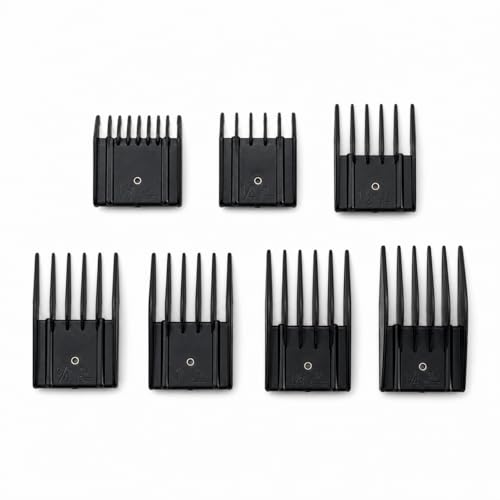
Universal Fit Design: Seven piece clipper guide comb set with spring loaded metal clip attaches to back of clipper blade and plastic comb that snaps over front of blade for secure fit

Professional Precision: Designed for smooth, time-saving finishes
Creating Clean Fades: Guard Transitions Explained
The difference between a sharp fade and a blotchy, lined haircut hinges on your mastery of guard shifts and the taper lever—two foundational tools that’ll elevate your cutting from basic to professional. Your fade techniques begin with the longest guard, progressing systematically toward shorter sizes as you move upward. This sequential approach prevents irreversible mistakes and allows corrections before advancing. Execute upward rocking motions at section tops, gradually angling the blade outward rather than pulling straight away. Your blending strategies incorporate taper lever adjustments between guard changes, creating progressively darker appearances. Cut against the grain consistently, maintaining blade contact with the scalp throughout overlapping strokes. Alternating lever positions—closed for sharp lines, open for blending—produces seamless changes across all sections. For optimal results during your fade work, consider using clippers with flexible heads that allow smooth transitions across contours. Each guard size corresponds to millimeters of hair length, ensuring precision and consistency throughout your fade transitions. Like dermaplaning on the face, maintaining minimal pressure throughout your cutting technique prevents irritation and ensures clean, professional results.
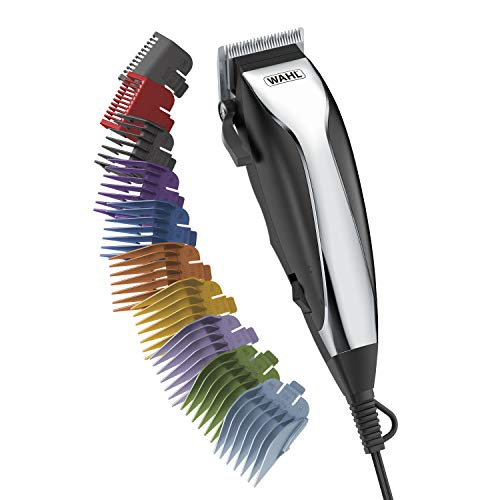
Multi-Cut Hair Clipper - Heavy duty motor for exceptional power and no-snag cutting; features an adjustable taper lever for easy blending and fading. This results in a very strong audible hum, but is completely normal to its operation. Don’t settle for a weak clipper.

Color Coded Guide Combs – Finding and remembering everyone’s favorite hair length is easier than ever. Corresponding the correct comb to the right cutting length is simple with our easy to see attachment guards
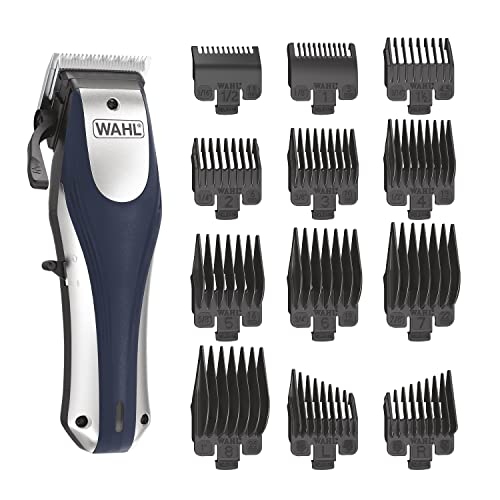
Cordless Operation – The power of a corded hair clipper with the convenience of a cordless; to use simply plug the clipper into charge and unplug when ready to use with cordless convenience
Common Mistakes When Choosing Clipper Guards
Even experienced barbers stumble when selecting clipper guards, and these missteps undermine the fade work you’ve perfected through proper guard changes. Guard size mistakes stem from mismatched brand specifications—Wahl and Andis guards vary slightly despite identical numbering. You’ll achieve shorter cuts than intended if you select undersized guards without testing first. Attachment errors compound these problems when you fail to secure guards firmly before cutting. Loose guards slip mid-cut, creating uneven results and safety hazards. Always verify guard compatibility with your clipper model, as incompatible attachments won’t snap securely into place. Before committing to your fade, test your chosen guard on a small inconspicuous section. After testing your guards and making your cuts, apply a soothing aftershave to calm the skin and reduce any irritation from the clipper work. To maintain consistent performance, oil your clippers every 10 minutes during use to prevent overheating and preserve cutting effectiveness. Regular maintenance prevents build-up and ensures your guards perform optimally throughout the cutting process. This approach prevents costly mistakes while ensuring consistent length across your client’s head.